A neighbor may receive dozens of crystal-clear local channels while a home a few miles away gets only a handful. The difference is often not the TV or the antenna box on the shelf. It is the signal path. An over the air television reception map gives you an early look at what your address may receive, how strong those stations are likely to be, and what kind of antenna system makes sense before you cut the cord.
For homeowners looking to lower a cable or satellite bill without giving up local news, live network shows, weather coverage, and major sporting events, that information is valuable. A reception map is a planning tool, not a guarantee. Read it correctly, though, and it can prevent the most common antenna mistake: buying based on promises on a package instead of the conditions at your home.
What an Over the Air Television Reception Map Shows
A television reception map estimates broadcast signal availability at a specific location. After entering an address, you will typically see a list of local stations, their network affiliations, estimated signal strength, distance from the broadcast tower, and the direction of that tower from your home.
Most maps group channels by color or signal category. A strong signal generally means indoor reception may be possible. Moderate signals may call for a window-mounted, attic, or outdoor antenna depending on the building and terrain. Weak or distant signals usually need a properly selected outdoor antenna mounted as high and as clear as practical.
The map also identifies the actual broadcast channel, often called the RF channel. This is different from the channel number that appears on your television. For example, a station branded as Channel 8 may transmit on a different physical frequency. That detail matters because antenna performance changes across VHF and UHF frequencies.
A good map may also show whether a station broadcasts on VHF or UHF. Many local stations are UHF, but VHF stations remain common in some markets. An antenna designed mainly for UHF may not deliver the same results on a VHF station, even if both stations appear on the same channel list.
Start With the Channels Your Household Actually Watches
Before focusing on colors, miles, or antenna range claims, make a short list of the local programming that matters most. For many households, that includes ABC, CBS, FOX, NBC, PBS, independent local stations, Spanish-language programming, and local news. Sports fans may also want specific network affiliates that carry regional games, NFL broadcasts, college sports, or major events.
Then compare that list with the map results. If the channels you care about are in the strongest signal group and come from a similar direction, your project may be relatively simple. If one must-have station is much weaker than the others or comes from the opposite side of the house, the antenna design requires more care.
This is where a map helps you make a practical decision. Getting 50 channels is not necessarily better than getting 20 channels if the 20 include every station your family watches. The goal is dependable access to the programming that makes canceling or reducing pay TV worthwhile.
Signal Strength Is Helpful, But It Is Not the Whole Story
Reception maps use prediction models. They account for transmitter location, estimated signal power, distance, and broad terrain conditions. What they cannot fully predict is every obstacle between the tower and your television.
A heavily wooded lot, a nearby hill, a metal roof, solar panels, stucco with wire mesh, foil-backed insulation, tall neighboring buildings, and even the materials inside your walls can affect reception. Signals can also reflect off large structures, creating multipath interference. That can cause a channel to appear during one scan but freeze, pixelate, or disappear at certain times.
Distance matters, but it should not be treated as the deciding number. A station 45 miles away across open, flat ground can be easier to receive than one 20 miles away behind a ridge. Likewise, a powerful indoor antenna can still struggle in a lower-level room surrounded by dense construction materials.
Think of the map as the first layer of the answer. A professional site review adds the conditions that no online tool can see: mounting height, roofline clearance, cable routes, splitter loss, grounding needs, and the best direction for the antenna.
Pay Close Attention to Tower Direction
The direction shown on a reception map is one of its most useful details. It tells you where an antenna needs a clear path to receive a station well. When most desired channels are clustered in one direction, a fixed directional antenna can often provide strong, stable results.
When stations are spread across different directions, the answer depends on the separation. A broader pickup pattern may work when towers are somewhat apart. In other homes, a directional antenna aimed at the priority stations delivers better overall reliability than trying to pull in every distant signal from every direction.
A rotor can be useful in select situations, but it is not always the best household solution. It adds moving parts and may be inconvenient if multiple televisions are in use. One person should not have to turn the antenna away from a football game so another person can watch local news in a different room.
Placement also changes the meaning of direction. An antenna mounted on the wrong side of a chimney, behind a roof peak, or below a mature tree canopy may have a compromised path even when it is pointed toward the correct tower. Small adjustments in height and location can make a noticeable difference.
Choose an Antenna Based on Conditions, Not Marketing Range
Retail antenna packages often promote large mileage numbers. Those numbers can be misleading because they do not describe terrain, building materials, tower power, frequency, or interference at your address. A “100-mile” antenna is not automatically better than a well-built antenna designed for a realistic 35-mile installation.
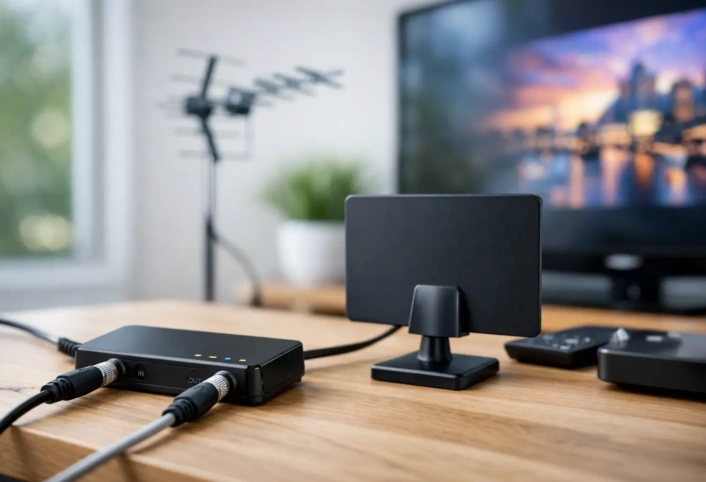
The map helps narrow the antenna type, but the home determines the final choice. Indoor antennas are convenient and can work well near strong transmitters. They are usually the least predictable option because walls, appliances, and room placement become part of the signal path.
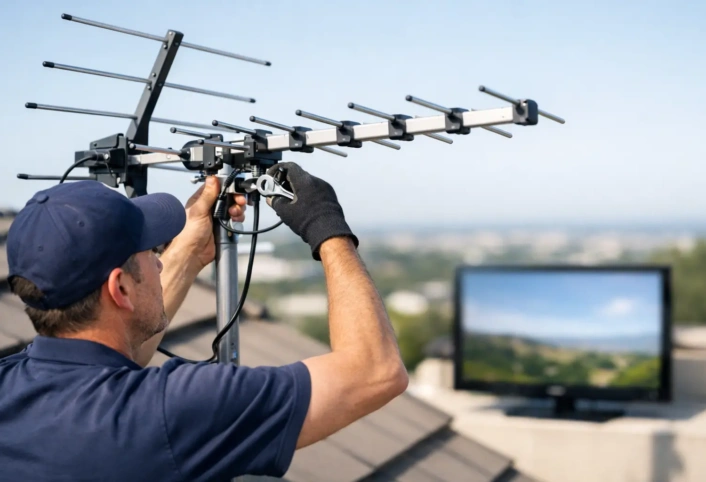
Attic installations keep equipment out of sight and protected from weather, but roof materials can reduce performance. Outdoor installations generally offer the best chance of stable reception because they can be mounted higher and away from interior obstructions. They also require proper mounting, weatherproof connections, cable management, and grounding.
Amplifiers are another area where more is not always better. A preamplifier can help overcome signal loss from a long cable run or multiple TV connections. But if signals are already strong, amplification can overload the tuner and make reception worse. The right system balances available signal with the loss created by the home’s wiring.
Use the Map to Plan for More Than One TV
A map tells you what may reach the antenna. It does not tell you how much of that signal will remain after it travels through your home. Every splitter, connector, wall plate, and length of coaxial cable introduces some loss.
For one television located near the antenna feed, a basic setup may be enough. For a household with televisions in the living room, bedrooms, kitchen, and patio, the distribution system deserves attention. Older cable wiring may be usable, but it should be tested rather than assumed to be ready for over-the-air signals.
This is also the point to consider whether you want a television-only antenna setup or an antenna integrated with streaming. Many households use free local broadcast channels for live programming and add a few streaming services for on-demand shows. That combination can reduce recurring costs while keeping the channels that are hardest to replace with streaming alone.
When a Reception Map Calls for Professional Help
Some homes are ideal for a simple antenna installation. Others have weak stations, challenging terrain, multiple television locations, or a difficult roofline. If your map shows borderline signals for the channels you care about, professional guidance can save money and frustration.
A trained antenna technician can evaluate the map, confirm real-world signal conditions, select an antenna that covers the needed VHF and UHF frequencies, and install it in a location designed for reliable performance. Just as important, the technician can configure the system for the number of TVs in the home and address the details that affect long-term results.
Antenna Master helps homeowners turn reception data into a practical cord-cutting plan. Instead of guessing from a store display, you can get a system designed around your address, local channels, home layout, and viewing priorities.
Use an over the air television reception map as the starting point, then let your must-have channels and your home’s real conditions guide the final decision. A well-planned antenna system can make local HD television feel simple again – without another expensive pay-TV contract.