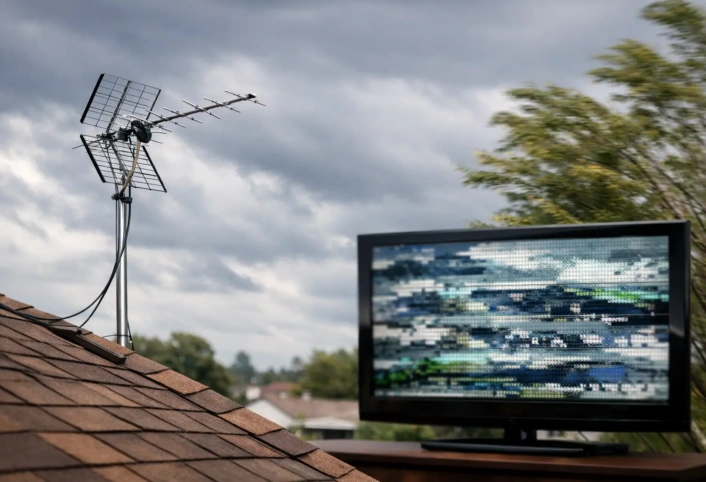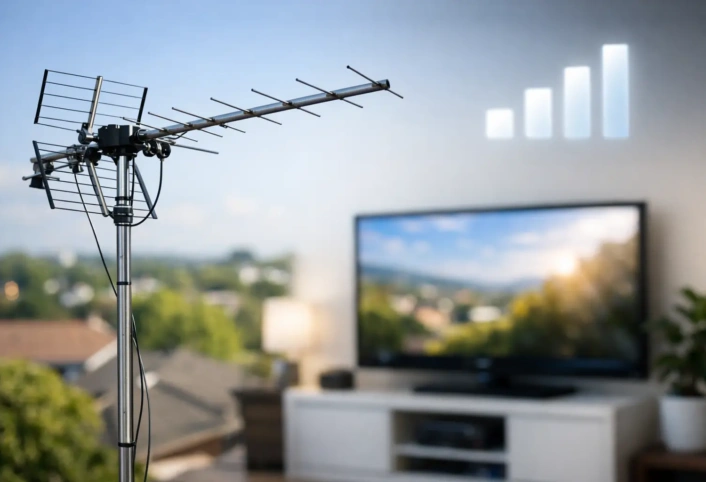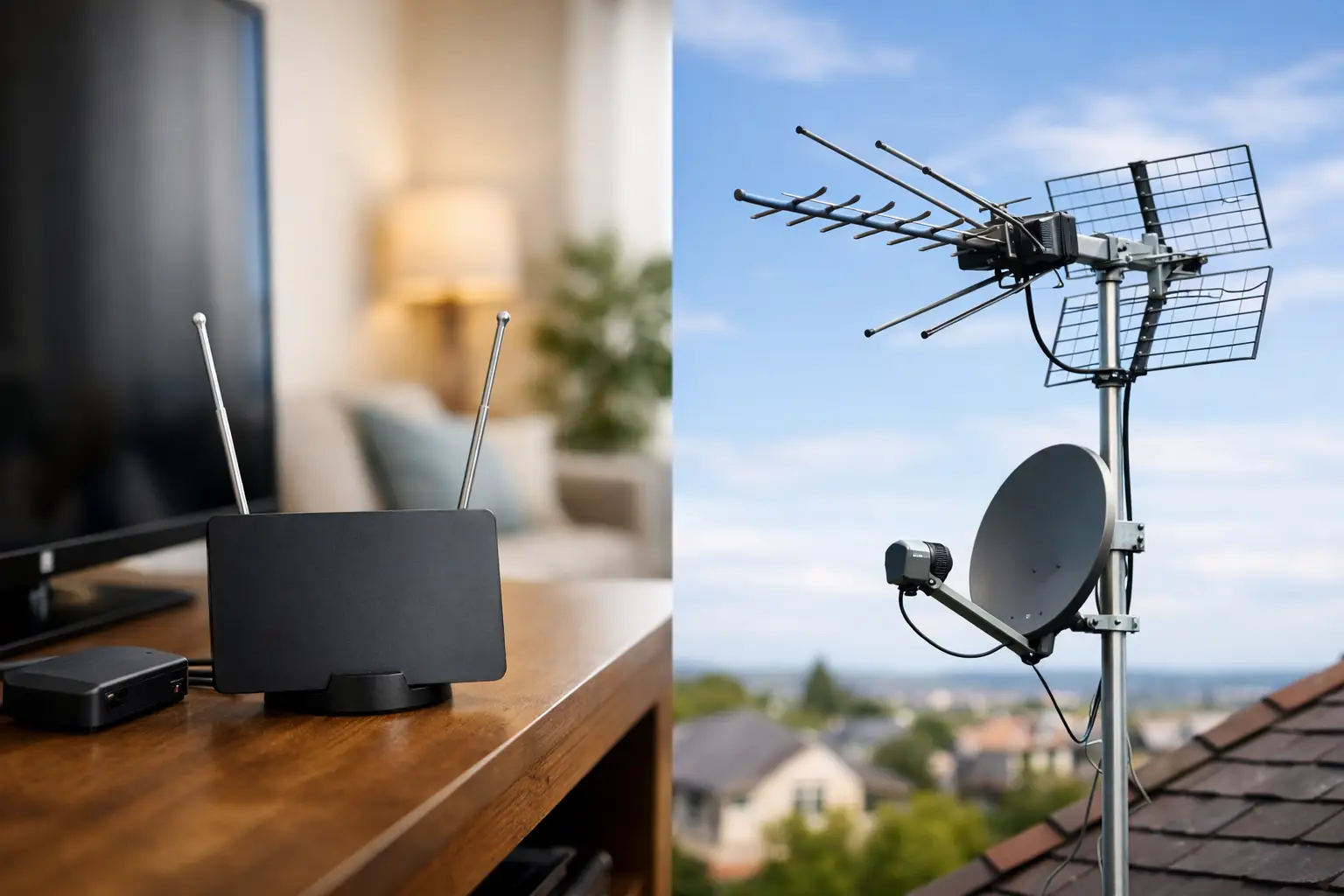
A cheap indoor antenna can look like the fastest route to free local TV. For some homes, it is. But the indoor vs outdoor TV antenna decision often determines whether you receive a handful of inconsistent channels or dependable access to local news, network shows, live sports, and weather in clear HD.
The right choice is not about buying the biggest antenna or mounting equipment where it looks best. It comes down to your distance from broadcast towers, the terrain around your home, building materials, and how many TVs you want to serve. Here is how to choose an antenna system that supports your cord-cutting goals instead of creating a new source of frustration.
Indoor vs Outdoor TV Antenna: The Main Difference
An antenna works by receiving broadcast signals traveling through the air from local TV towers. Those signals can be weakened by distance, hills, trees, walls, roofing, wiring, and even the metal coating in energy-efficient windows. The fewer obstacles between the antenna and the towers, the better your odds of stable reception.
An indoor antenna sits inside the home, usually near a window or on a wall. It is simple to try, takes little space, and requires no exterior installation. An outdoor antenna is mounted above or outside the home, often on a roofline, eave, chimney mount, or mast. Its higher placement and clearer signal path typically give it a major reception advantage.
That does not mean every household needs an outdoor antenna. A home close to broadcast towers may receive strong signals indoors. A home farther away, in a wooded area, or behind hills may need the added height and performance of an outdoor system to receive the channels that matter most.
When an Indoor Antenna Makes Sense
Indoor antennas are a reasonable starting point when your home is relatively close to the major broadcast towers and you only need to connect one TV. They can be a practical choice for apartments, rentals, guest rooms, or homeowners who want to test local reception before investing in a permanent system.
Placement matters more than the slim design shown on the box. An indoor antenna may work well near a higher window facing the tower direction, then perform poorly when moved a few feet behind a television or next to other electronics. Walls, appliances, and the TV itself can interfere with reception.
Indoor antennas are best suited for straightforward situations. If you have clear local towers nearby and want the main network affiliates, you may get solid results with a carefully placed model. But signal strength alone does not tell the full story. A channel can appear during a scan yet break up during bad weather, at certain times of day, or when people move around the room.
The biggest trade-off is consistency. An indoor antenna is more exposed to interference inside the house and has less ability to overcome difficult reception conditions. It may be enough for casual viewing, but it is less likely to deliver the reliability many households expect for live games, breaking news, and daily programming.
Why Outdoor Antennas Usually Deliver Better Reception
For homeowners who want a dependable cord-cutting setup, an outdoor antenna is often the stronger long-term solution. Elevation matters. Mounting an antenna outside and higher on the home can help it receive signals before they are weakened by walls, roofing, insulation, and household interference.
Outdoor antennas also come in designs built for specific reception needs. Some are designed to receive stations in one general direction. Others have a wider pickup pattern for markets where towers are spread out. Choosing the right style is more useful than simply choosing an antenna advertised with the longest mileage range.
A professionally planned outdoor installation can also support more than one television. Instead of giving one room good reception and leaving the rest of the home behind, the system can be configured to distribute antenna signals through appropriate wiring and equipment. That makes local HD programming available where your family actually watches TV.
Weather is a common concern, but quality outdoor antennas are made for exterior use. The installation itself matters just as much as the antenna. Proper mounting, grounding, cable routing, weatherproof connections, and secure hardware help protect performance and the home. A loose mount or poorly sealed cable entry can turn a good antenna into an unreliable system.
Factors That Matter More Than Antenna Size
A larger antenna is not automatically better, and a powered antenna is not automatically stronger. The best setup is the one matched to your home and local signal conditions.
Distance and direction of local TV towers
Homes near a cluster of towers may need only a compact antenna with a broad reception pattern. Homes farther from the towers may benefit from a more directional antenna aimed precisely toward the broadcast source. If the stations you want are located in different directions, the system needs to account for that rather than assuming one aim point will serve every channel.
Terrain and surrounding obstacles
Hills, dense trees, neighboring buildings, and low-lying locations can all reduce signal quality. In these cases, moving the antenna outdoors and increasing its elevation can make a noticeable difference. A roof-mounted antenna may still face obstacles, but it has a better chance of finding a usable signal path than an antenna placed behind several interior walls.
Your home’s construction
Modern homes can be surprisingly difficult for indoor reception. Stucco, brick, metal siding, foil-backed insulation, radiant barriers, and low-E glass may weaken signals. If an indoor antenna only works in one narrow spot or loses channels when the room changes, the building itself may be the obstacle.
The number of TVs in your home
Connecting several TVs changes the design. Splitting a signal reduces its strength, and adding the wrong amplifier can create problems instead of solving them. A properly designed multi-TV system balances the incoming signal, cable runs, splitters, and any needed amplification so every television has a fair chance at clean reception.
Can an Attic Antenna Be a Good Compromise?
An attic installation can be a useful middle ground for homeowners who want something less visible than a roof-mounted antenna. It is protected from direct weather and may sit higher than an indoor antenna. In the right home, it can provide good results.
Still, an attic is not the same as outdoors. Roofing materials, insulation, ductwork, solar equipment, and metal structures can weaken or reflect broadcast signals. An attic antenna may perform very well in one house and disappoint in another with nearly identical tower distances. It is a reasonable option when exterior mounting is not preferred, but it should be evaluated as its own reception environment.
Avoid the Most Common Antenna Mistakes
The first mistake is relying on a package claim instead of the signal conditions at your address. Reception ranges printed on retail boxes are estimates, not promises. A listed range cannot account for your roofline, nearby trees, terrain, or the direction of local towers.
The second is putting an indoor antenna behind the TV and expecting strong results. That location is convenient, but it is rarely ideal. Higher placement near a suitable window can be better, although it still may not overcome difficult conditions.
The third is adding an amplifier whenever channels are weak. Amplifiers can help compensate for long cable runs or signal loss from splitting to multiple TVs. They cannot create a clean signal where the antenna receives mostly noise. In some cases, amplification can overload strong nearby signals and make reception worse.
Finally, avoid treating antenna installation as a one-size-fits-all purchase. The goal is not merely to scan in the most channels once. The goal is to receive the local stations you care about consistently, on the televisions your household uses, without a cable or satellite bill dictating your entertainment budget.
Choosing the Right Setup for Your Home
Choose an indoor antenna when you are close to local broadcast towers, have a simple one-TV need, and can place it in a favorable location. Choose an outdoor antenna when reliable reception matters, your home faces reception obstacles, you are farther from towers, or you want to serve multiple TVs.
For many homeowners, the value of a professional antenna installation is knowing the system has been selected and positioned for actual conditions, not guessed from a store shelf. A trained technician can evaluate signal direction, mounting options, wiring needs, and the practical trade-offs before recommending equipment.
Cutting the cord should leave you with more control, not more troubleshooting. If local channels are a regular part of your household routine, a properly matched antenna system can make that monthly TV bill easier to leave behind while keeping the programming you depend on close at hand.