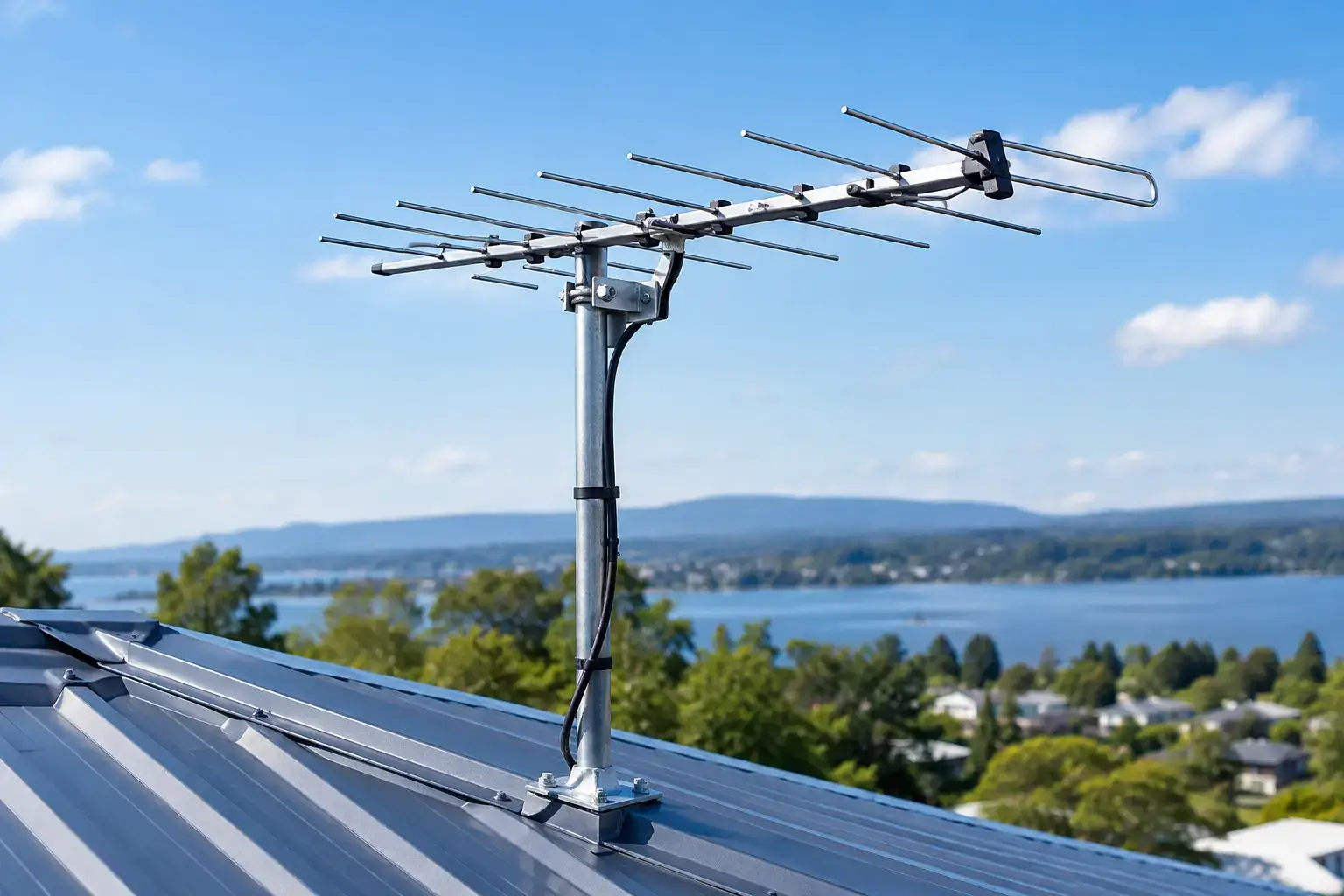
A metal roof changes the installation plan, not your ability to enjoy free local television. Metal roof antennas can provide excellent over-the-air HD reception when the antenna is mounted in the right location, positioned for available broadcast signals, and installed with the roof system in mind.
For homeowners cutting the cord, the goal is simple: dependable access to local news, network shows, live sports, weather, and more without relying entirely on a pay-TV provider. A metal roof does add a few technical considerations, but it is not a reason to settle for weak reception or an indoor antenna that only works on a good day.
Can You Install an Antenna on a Metal Roof?
Yes. A television antenna can be installed on or near a metal roof, provided the mounting method, height, grounding, and cable routing are handled correctly. The roof itself does not automatically prevent an outdoor antenna from receiving broadcast signals.
The bigger question is where the antenna sits in relation to the roof. If the antenna is mounted above the roofline or on a properly placed side mount, it has a clearer path toward local broadcast towers. That often matters far more than the fact that the roofing material is metal.
Metal can affect radio-frequency behavior around an antenna, especially when the antenna is mounted too close to the roof surface or tucked into a poor location. It can also block reception when a homeowner tries to hide an antenna inside the attic beneath a metal roof. An exterior installation, planned around the home and local signal conditions, is usually the more reliable approach.
Why Placement Matters More Than the Roof Material
Broadcast television signals travel from local transmission towers to your antenna. Trees, neighboring buildings, distance from the towers, elevation, and the direction your home faces can all influence what reaches your TV. The antenna needs a practical line of sight or the best available signal path, not simply the highest point on the house.
With metal roof antennas, adequate separation from the roof surface helps prevent the roofing material from interfering with the antenna’s performance pattern. A technician may use a mast that raises the antenna above the roofline, a chimney mount when appropriate, or a side-wall mount that gives the antenna a clear direction toward the towers.
The right option depends on the property. A higher mount can improve signal access, but height also increases exposure to wind. A side mount may be less visible and easier to service, but it must still face the right signal path. Good antenna work is not about choosing one mounting style for every home. It is about matching the installation to reception conditions and the structure itself.
Avoid the Attic Shortcut
Attic antenna installations can be appealing because the equipment is hidden. Under a metal roof, however, that convenience often comes with weaker or inconsistent reception. The metal panels, underlayment, insulation, wiring, HVAC equipment, and framing can all create obstacles between the antenna and broadcast signals.
An attic location may work in limited situations, especially when transmitters are close and signals are strong. But for households that want dependable local channels, an outdoor antenna is generally the better choice. It gives the system a clearer opportunity to receive the signals that matter most.
Mounting an Antenna Without Damaging the Roof
A metal roof is a long-term investment, so the antenna mount must respect the roofing system. Improper fasteners, poorly sealed penetrations, or incompatible metals can create problems that have nothing to do with television reception.
Professional installers evaluate whether a non-penetrating mount, side mount, chimney mount, or another method makes sense for the home. When a roof penetration is necessary, it should be properly sealed and flashed using materials suited to the roof. The goal is to secure the antenna assembly without creating a leak path or compromising the roof’s finish.
Material compatibility also matters. Certain combinations of metals can corrode when exposed to moisture over time. In South Florida, heat, heavy rain, salt air near the coast, and storm-season winds make thoughtful mounting especially valuable. The mount, mast, hardware, and sealing methods should be selected for the environment, not just whatever is available in a retail box.
Wind Load Is Part of the Plan
An antenna and mast act like a small sail in strong wind. Larger antennas can offer better reception in challenging locations, but they also place greater stress on the mounting point. The correct antenna is not always the largest one.
A technician considers antenna size, mast length, mount strength, roof geometry, and the area’s weather exposure. A stable installation protects both reception and the home. If the antenna shifts after a storm, even a small change in direction can affect channel availability.
Grounding and Cable Routing Protect the System
Grounding is one of the most overlooked parts of a TV antenna installation. It is not an optional finishing touch. A correctly grounded antenna system helps manage electrical surges and gives the installation a safer, more professional setup.
The antenna mast and coaxial cable should be grounded according to applicable electrical standards. This involves more than attaching a wire wherever it is convenient. Grounding location, wire type, bonding, and cable entry all need to be considered together.
Cable routing deserves the same attention. Coaxial cable should be secured neatly, protected from sharp metal edges, and routed to minimize unnecessary exposure and damage. Entry points into the home should be sealed properly. A clean cable path helps preserve signal quality and keeps the outside of the home looking organized.
Choosing the Right Antenna for a Metal Roof
There is no single best antenna for every metal-roof home. Your distance from broadcast towers, the channels you want, surrounding obstacles, and the number of televisions all shape the recommendation.
A compact directional antenna may be ideal when most stations are in one direction. A multidirectional model can help when broadcast towers are spread across different areas. In more difficult locations, a larger directional antenna or carefully selected amplifier may be appropriate. An amplifier is not a cure for a poorly placed antenna, though. It can increase usable signal, but it can also amplify noise if the antenna is in the wrong spot.
This is why reception testing is valuable. Instead of guessing based on packaging claims, a professional installation starts with the real conditions at your address. The result is a system designed around the channels available to your home and the way your household watches TV.
What a Professional Installation Changes
A DIY antenna can work well in a simple situation. But metal roofing adds enough structural and reception variables that professional guidance often saves homeowners from repeat adjustments, loose mounts, water concerns, and frustrating channel dropouts.
A trained technician can evaluate signal direction, choose an appropriate mounting approach, set the antenna’s aim, ground the system, route the cable, and test reception at the television. If you want to feed multiple TVs, the technician can also account for signal distribution so one room does not get a great picture while another struggles.
Antenna Master helps homeowners in Miami-Dade, Broward, and Monroe counties turn cord-cutting plans into working TV systems. The focus is not simply putting an antenna on a roof. It is delivering clear local HD television with an installation that suits the home.
A Better View Starts Above the Interference
A metal roof should not stand between your household and dependable local TV. With the antenna positioned above or beside the roof correctly, secured for the conditions, and tested for the channels you want, it can become the foundation for a cleaner cord-cutting setup. A thoughtful on-site assessment is the best next step when clear reception matters as much as protecting your home.