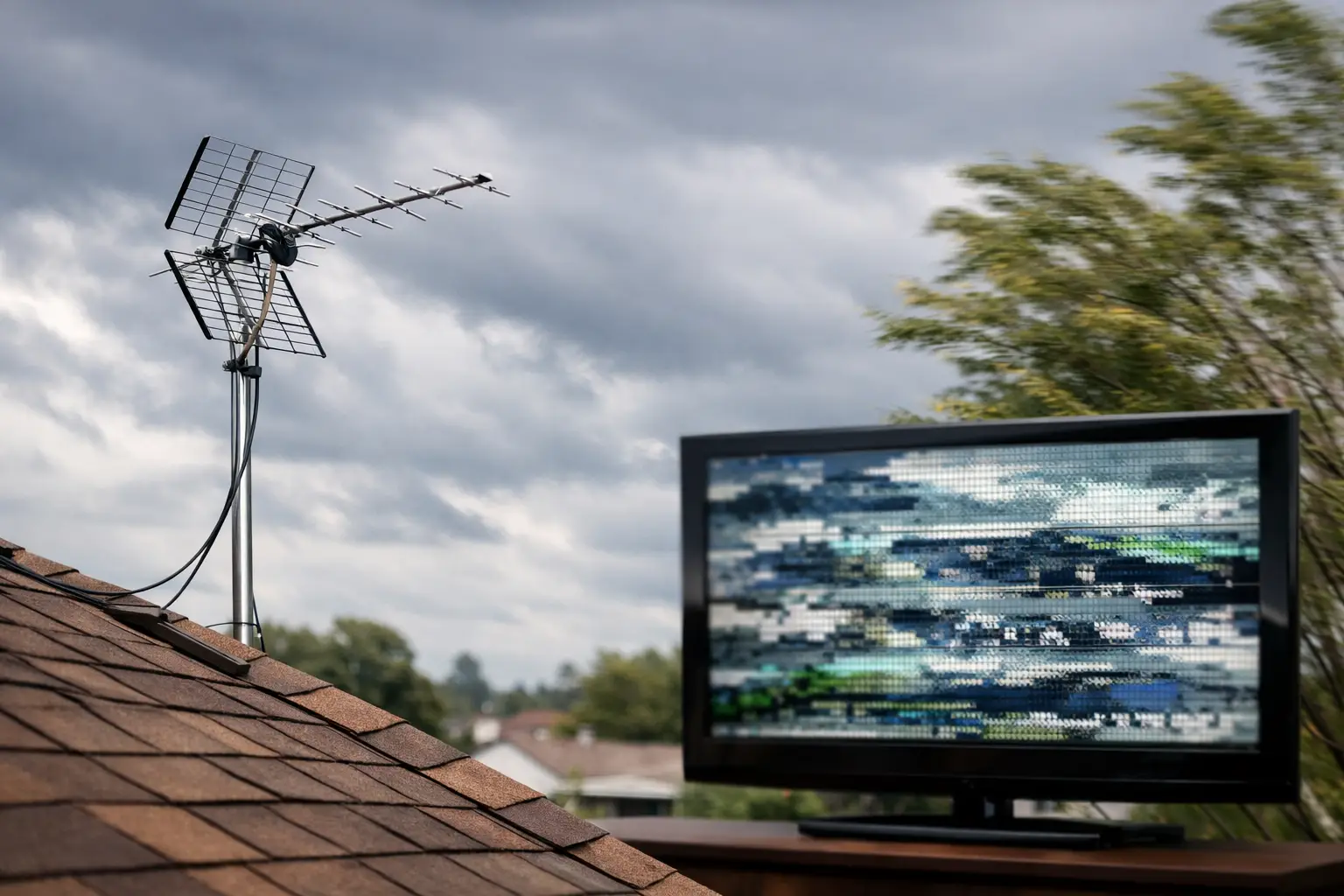
A clear local newscast that breaks into pixels every time a front moves through is more than an annoyance. Bad TV reception when windy is usually a clue that something in the antenna system is moving, weakening, or allowing interference into the signal path. The good news is that wind-related reception trouble is often diagnosable – and, with the right repair, preventable.
For homeowners who rely on an antenna for free local HD channels, the goal is not simply to get channels on a calm day. It is to get dependable reception through changing weather, seasonal foliage, and the occasional strong gust.
Why TV Reception Gets Worse in the Wind
Wind does not normally stop broadcast signals from reaching your home. Television stations transmit continuously, and normal wind has very little direct effect on those signals. Instead, wind exposes a weak point in your equipment, installation, or signal environment.
An outdoor antenna can move slightly on a loose mast, bracket, or mounting surface. That small movement may be enough to shift a directional antenna away from the broadcast towers. At the same time, a worn coaxial connection can momentarily lose contact as the cable flexes. Both problems can cause freezing, pixelation, audio dropouts, or channels that disappear until the wind settles.
Wind can also move trees, branches, and nearby structures in the antenna’s signal path. Broadcast signals can reflect off buildings and other surfaces. When those reflections change, the TV tuner may receive several versions of the same signal at slightly different times. This is called multipath interference, and it can make one channel unstable even when other channels look perfect.
The Most Common Causes of Bad TV Reception When Windy
A loose antenna mount or mast
Your antenna needs a secure, stable foundation. If the mast rocks, the mounting brackets flex, or the hardware has loosened over time, the antenna’s aim can change with every gust. Directional antennas are especially sensitive because they are designed to focus on signals coming from a particular direction.
Look for obvious signs from the ground: an antenna that appears tilted, a mast that is no longer straight, or cables that sway and pull against the mounting point. Do not climb onto the roof to test a mount. A roof, ladder, and windy conditions are a risky combination, and a professional can inspect the entire assembly safely.
A damaged or poorly secured coaxial cable
The coaxial cable carries the signal from the antenna to your television or splitter. If it is cracked, pinched, frayed, or loose at a connector, wind movement can turn a minor weakness into an intermittent failure. Water can enter damaged cable or fittings, too, creating corrosion that gradually reduces signal quality.
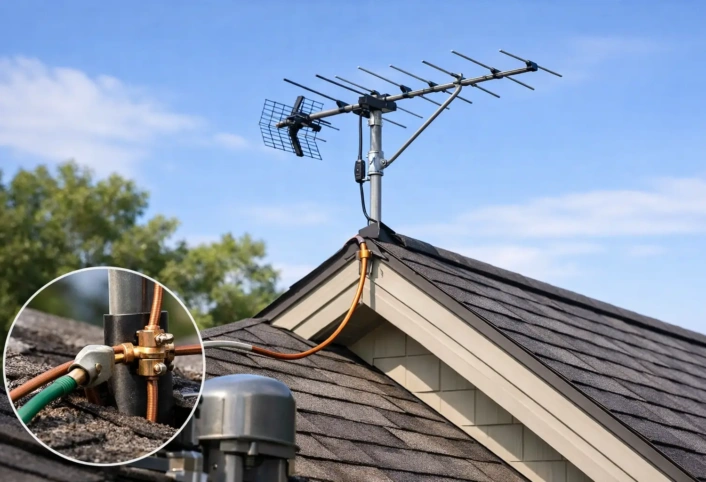
A cable should be properly supported along the mast and exterior wall, with enough slack to avoid strain but not so much that it flaps in the wind. Outdoor connections need weather protection. Electrical tape alone is not a lasting weatherproofing solution.
Trees and changing obstructions
If reception is worse only when trees are blowing, the antenna may have a partially blocked path to the towers. Leaves, wet branches, and moving limbs can absorb or scatter signal. This is often most noticeable in summer, when dense foliage fills in a path that was clear during winter.
Sometimes trimming can help, but not every property has a simple line-of-sight solution. Moving the antenna higher, selecting a different mounting location, or using an antenna designed for the local signal conditions may provide a more reliable result. It depends on where the broadcast towers are located and which channels matter most to your household.
An antenna that is aimed for a calm-day signal only
A TV may display every expected channel after a basic channel scan, yet still have little signal margin. In other words, the system works when conditions are ideal but falls apart when anything changes. This can happen when an antenna is aimed by trial and error, is undersized for the location, or is receiving a weak reflected signal rather than the strongest available signal.
More antenna gain is not always the answer. In areas with strong nearby stations, an oversized amplified antenna can overload the tuner or amplifier. In fringe-reception areas, however, a larger directional antenna and carefully planned placement may be exactly what the system needs. A proper evaluation looks at signal strength, signal quality, tower direction, terrain, and the number of TVs served.
Failing amplifiers, splitters, or indoor connections
If an antenna feeds several TVs, the signal is divided each time it passes through a splitter. An older splitter, loose wall plate, failing amplifier, or poorly installed connector can create a weak link. Wind may not directly affect an indoor component, but it can expose a system that already has very little signal to spare.
A distribution amplifier can help compensate for signal loss in some multi-TV homes. It cannot fix a loose roof mount, a damaged cable, or an antenna pointed in the wrong direction. Adding amplification before finding the source of the problem can make diagnosis harder.
What You Can Check Safely From Inside and From the Ground
Start by noticing the pattern. Does every channel fail, or only one network? Does the problem affect all TVs in the home? Does it happen only during high wind, or also during rain? These details help separate an antenna alignment issue from a cable, splitter, or station-specific reception issue.
From inside, make sure the coaxial cable is hand-tight at the TV and at any accessible splitter or wall connection. Avoid using tools to overtighten connectors. Check whether a powered amplifier is plugged in and whether its power indicator is on, if applicable.
From the ground, inspect the visible cable route and antenna position without touching rooftop equipment. Watch for a drooping cable, loose clips, a visibly leaning mast, or branches that repeatedly pass in front of the antenna. If the antenna or mast is moving noticeably, stop there and schedule service rather than trying a temporary fix.
It can also help to use your TV’s built-in signal meter while channels are working. Signal quality is often more useful than raw signal strength. A strong signal with poor quality can still produce pixelation, especially when the antenna receives reflections or interference.
Why Rescanning Usually Does Not Fix the Problem
A channel scan tells the television which channels it can find at that moment. It does not tighten a connector, stabilize a mount, repair weather damage, or improve the antenna’s aim. Rescanning during a windy outage may even remove channels that return once conditions improve.
Save a rescan for after a repair, antenna adjustment, or major change in local broadcast assignments. If channels vanish only in gusty weather and return afterward, the system needs an inspection more than another scan.
When It Is Time for a Professional Antenna Inspection
Call for service when reception problems return with each wind event, the antenna or mast appears unstable, cables show weather damage, or several TVs lose channels at once. Those symptoms often point to equipment that needs more than a quick indoor adjustment.
A trained antenna technician can verify mounting strength, inspect weatherproofing, test the coaxial run, evaluate splitters and amplifiers, and measure signal quality at the antenna and at each TV location. Just as valuable, the technician can confirm whether the antenna is suited to your home’s location instead of guessing based on a retail box.
Antenna Master approaches reception problems as a complete home system. That means finding the actual point of failure, whether it is a mount, cable, connection, antenna position, or signal-distribution issue. The result is a setup built to support the local channels your family watches without the recurring cost of a cable or satellite package.
Build for Reliable Reception, Not Just Today’s Weather
A professionally installed antenna should be secured with appropriate mounting hardware, protected outdoor connections, correctly routed cable, and an antenna selected for the available signals. These details may not be visible from the living room, but they make the difference when weather changes.
If your picture is clear only when the air is still, treat that as useful information rather than something to live with. A focused inspection can turn an unreliable cord-cutting setup into the dependable source of local news, live sports, and HD programming it should be.