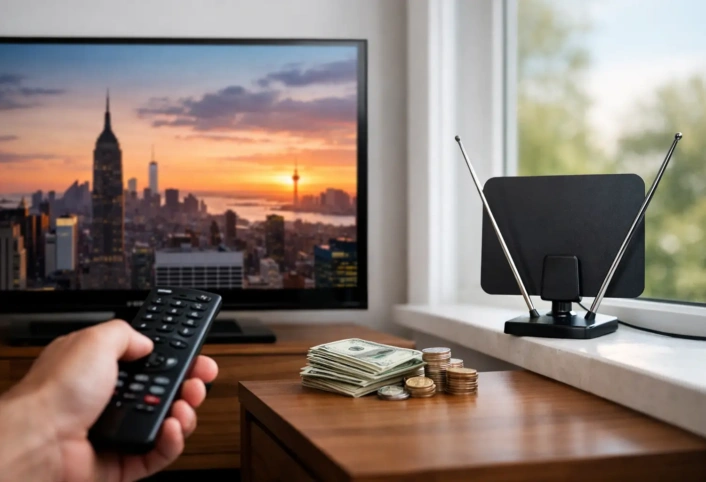
A small antenna beside the TV can be enough for one home and a daily source of frustration for the house next door. That is the real question behind indoor versus outdoor antennas: not which one looks easier to buy, but which one can deliver the local channels your household wants with dependable picture quality.
Broadcast TV is still a smart way to keep local news, major network programming, live sports, and HD channels without relying entirely on cable or satellite. But antenna performance depends on more than the label on the box. Distance from broadcast towers, building materials, elevation, nearby trees, and the number of TVs in the home all affect the result.
Indoor Versus Outdoor Antennas: The Core Difference
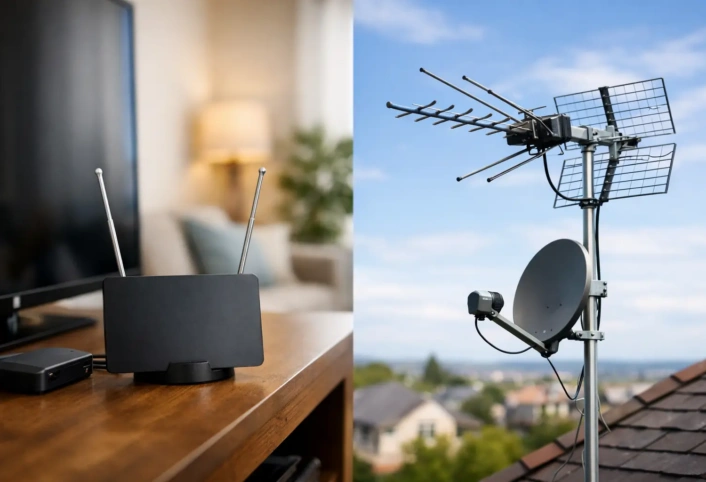
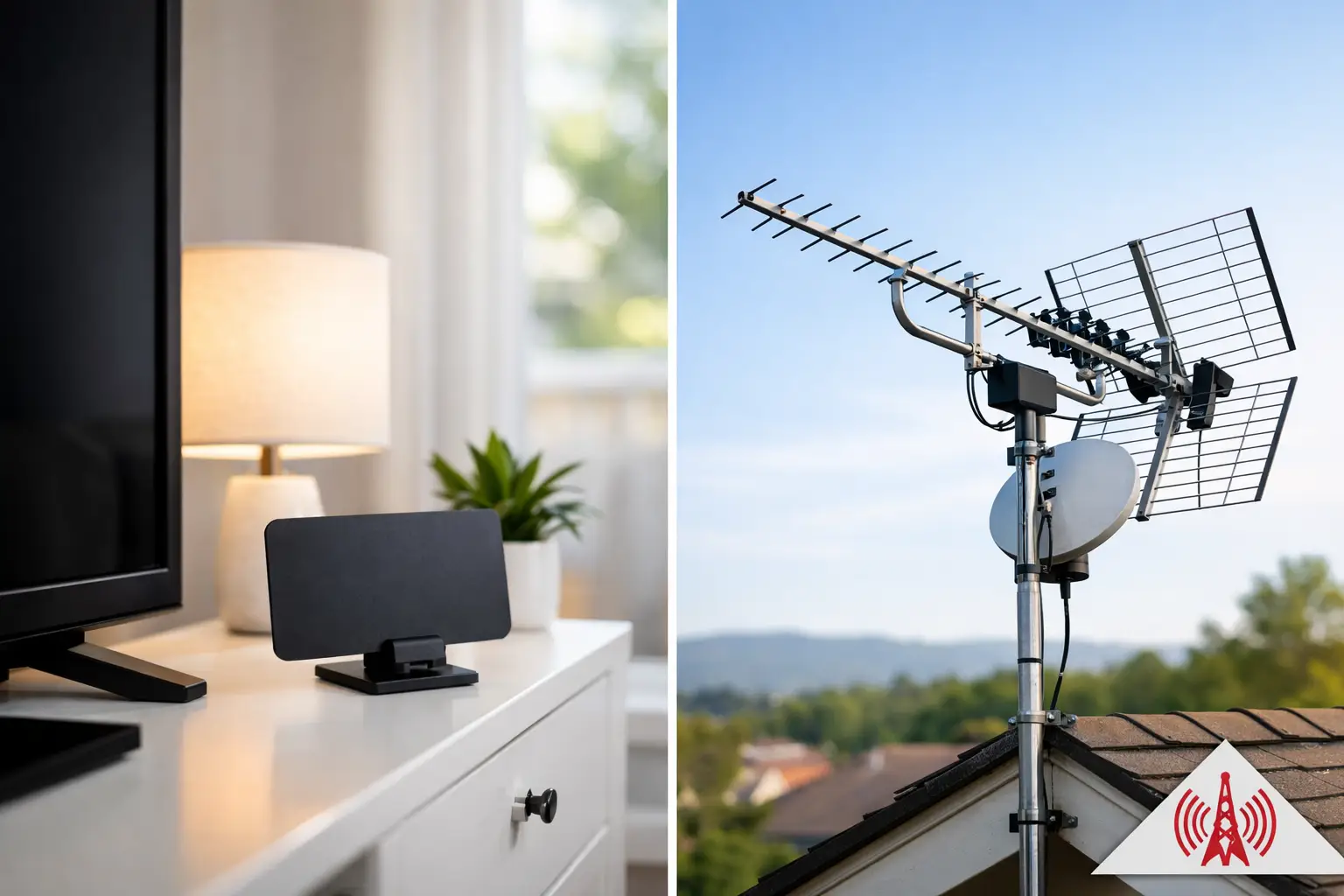
The main difference is placement. An indoor antenna works from inside the home, often near a television or window. An outdoor antenna is mounted outside, typically on a roof, exterior wall, attic location, or existing mast, where it has a clearer path toward broadcast signals.
That clearer path is why outdoor antennas usually provide stronger and more consistent reception. Walls, roofing, metal, concrete, low-E windows, and household electronics can weaken or interfere with signals before they reach an indoor antenna. An outdoor installation reduces many of those obstacles and gives the antenna more height, which can make a meaningful difference.
Still, outdoor is not automatically the only answer. If your home is close to local transmitters and has favorable signal conditions, an indoor antenna may receive the channels you need. The right choice comes down to your location and how reliable you need the system to be.
When an Indoor Antenna Can Make Sense
An indoor antenna is often appealing because it is compact and requires little setup. It can be a reasonable option for a single television in a home or apartment with strong local signal availability. Some households get clear reception simply by placing the antenna high on a wall or near a window facing the broadcast towers.
Indoor antennas are also useful as a quick starting point for people who mainly want a few major local stations. If the picture is stable, the channel scan finds the programming you expect, and the antenna does not need constant repositioning, there may be no reason to make the setup more complex.
The limitation is that indoor reception can be sensitive. A channel that works well in the morning may pixelate during certain weather conditions or disappear after furniture is moved. Even walking near the antenna can affect performance in some homes. Amplifiers may help in specific situations, but they cannot create a clean signal when walls and location are blocking too much of it.
For a household that depends on local channels for regular viewing, an indoor antenna can become inconvenient if it requires repeated adjustments. Convenience matters, especially when a live game, local weather update, or evening news broadcast is the reason you installed an antenna in the first place.
Why Outdoor Antennas Deliver More Reliable Reception
Outdoor antennas are built to capture signals before they have to pass through much of the home. Mounting the antenna higher and outside often improves its line of sight to transmission towers. That can increase the number of channels received, improve picture stability, and reduce the dropouts that make over-the-air TV feel unpredictable.
This is especially valuable in homes farther from broadcast towers, areas with dense development, or properties surrounded by tall trees. In South Florida, the landscape can create its own challenges. Dense construction, concrete block walls, tropical foliage, and changing weather conditions can all influence signal travel. A professionally selected and positioned outdoor antenna gives the system a better chance to perform consistently.
Outdoor antennas can also support a whole-home setup more effectively. Rather than placing a separate antenna at every television, one properly designed system may distribute over-the-air programming to multiple TVs. The antenna, cabling, signal distribution equipment, and grounding all need to work together. That is where an installation plan matters more than simply choosing the largest antenna available.
An outdoor system does require careful mounting and weather-ready connections. The goal is not just to receive channels on installation day. It is to create a stable setup that remains dependable through rain, heat, wind, and everyday use.
Attic Antennas: A Middle-Ground Option
An attic antenna can be a useful compromise when exterior mounting is not preferred or permitted. It is protected from direct weather exposure and usually has more elevation than a living-room antenna. For some homes, that is enough to produce strong reception.
However, attic performance varies widely. Metal roofing, radiant barriers, wiring, ductwork, insulation, and solar equipment can interfere with signals. An attic antenna may perform much better than an indoor model, but it still does not have the open exposure of an exterior installation. Testing the available signal and the building conditions is the best way to determine whether an attic location is a practical choice.
What Actually Determines Antenna Performance
Antenna type is only one part of reception. The best setup starts with the signals available at your specific address and the obstacles between your home and the broadcast towers.
Distance matters, but it is not the whole story. A nearby tower can still be difficult to receive if a large building blocks the path. A more distant station may come in clearly from an elevated roofline with a properly aimed antenna. Terrain, surrounding structures, tree cover, antenna direction, and cable length all play a role.
The number of televisions also changes the plan. Splitting one signal across several TVs can reduce signal strength if the system is not designed correctly. In some cases, a distribution amplifier is appropriate. In others, amplification can worsen reception by increasing unwanted noise or overloading already strong signals. Equipment should be selected based on actual signal conditions, not guesswork.
Channel goals matter as well. A household that only needs a few nearby network affiliates may have different needs than one trying to receive a broader mix of local and independent stations. Reliable reception is about matching the equipment and placement to what you want to watch.
Signs an Outdoor Antenna Is the Better Choice
An outdoor antenna is often the stronger option when your indoor antenna picks up channels inconsistently, requires frequent repositioning, or struggles during weather changes. It is also worth considering when you want to feed multiple televisions, receive stations from farther away, or keep the antenna out of sight.
It can be the better long-term choice for homeowners who want their cord-cutting setup to feel permanent rather than temporary. A professionally installed system can be aimed, secured, grounded, connected to the home’s existing TV wiring when appropriate, and configured for the televisions you use every day.
That does not mean every home needs a large roof-mounted antenna. The most effective antenna is the one that fits the available signals and installation environment. Oversized equipment in the wrong location can be less useful than a well-chosen antenna mounted correctly.
Professional Installation Removes the Guesswork
DIY antenna kits make television reception look simple, and sometimes it is. But when reception is weak, channel availability is unclear, or several TVs need to work from one system, trial and error can become a frustrating weekend project.
A trained technician evaluates the property, identifies viable mounting options, selects equipment for the signal conditions, and tests the result. That process helps avoid common problems such as poor antenna placement, unnecessary amplifiers, loose connections, weak splitters, and cables that limit performance.
For homeowners in Miami-Dade, Broward, and Monroe counties, Antenna Master helps turn broadcast reception into a dependable home TV solution. The focus is straightforward: clear local HD programming, a system suited to your home, and less dependence on paid TV services.
Before choosing between indoor and outdoor antennas, think about the channels you want, the TVs you need to serve, and how much reliability matters to your household. The right antenna should disappear into the background and let you enjoy the programs you turned it on to watch.