A perfect-looking antenna can still produce a frustrating TV picture if antenna signal strength is not right for your home. One channel may look sharp, another may freeze during a big game, and a third may disappear after a storm. The difference is rarely as simple as buying a bigger antenna. It comes down to local broadcast signals, your home’s location, correct equipment, and professional placement.
For homeowners ready to cut the cord, dependable over-the-air TV starts with understanding what affects reception. A properly designed antenna system can deliver local news, network shows, live sports, and more in high definition without another monthly cable or satellite bill.
What Antenna Signal Strength Really Means
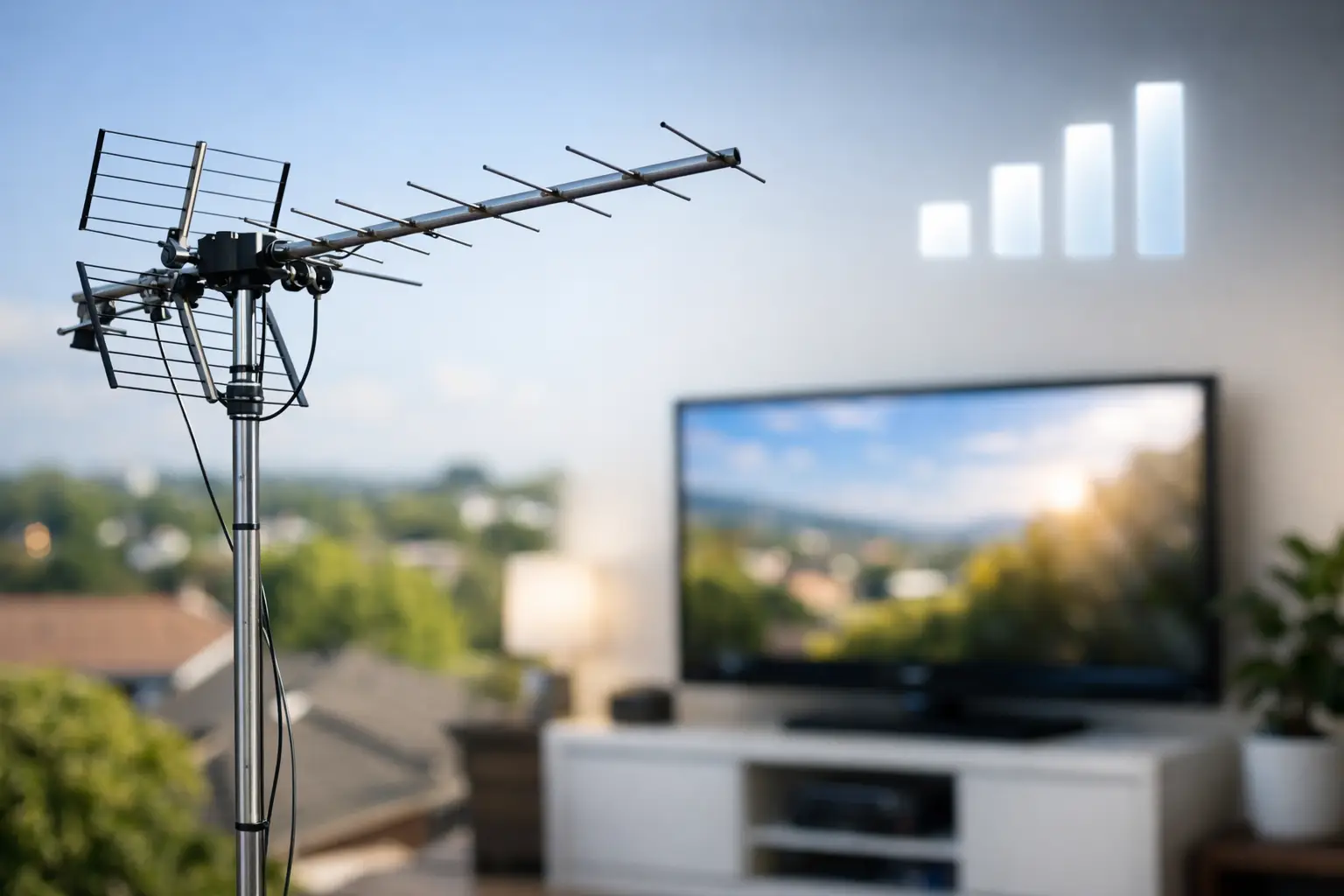
Antenna signal strength describes how much usable broadcast signal reaches your television tuner. Stronger is generally better, but strength is only part of the picture. A signal also needs to be clean enough for your TV to decode it consistently.
Digital television does not gradually become snowy the way old analog TV did. It tends to work clearly until the signal drops below a usable threshold. Then the picture may pixelate, sound may cut out, or the channel may vanish altogether. That is why a channel can appear perfect at noon and become unreliable later in the day.
Reception quality depends on three related factors: signal power, signal quality, and interference. A powerful signal with heavy interference can be unreliable. A modest signal with little interference can work very well. The goal is not simply to get the highest reading possible. The goal is stable, watchable TV on the local channels your household wants.
Why One Home Gets More Channels Than Another
Two homes on the same street can have very different results. Elevation, rooflines, nearby trees, building materials, and the direction of local broadcast towers all matter.
Distance is a major factor. Broadcast signals weaken as they travel, so homes farther from the transmission towers usually need more careful antenna selection and placement. But distance alone does not tell the whole story. A home 35 miles from the towers with a clear path may receive excellent channels, while a home 15 miles away in a valley or behind dense development may have more difficulty.
Terrain creates some of the biggest challenges. Hills, ridges, and low-lying areas can block or reflect signals. Tall buildings, water towers, and large stands of trees can do the same. Trees are especially unpredictable because wet leaves, seasonal growth, and wind can change reception. A system that works in winter may need a different approach once foliage fills in during spring and summer.
Your home itself also affects reception. Metal roofs, radiant barriers, stucco with wire mesh, solar panels, brick, and certain window coatings can weaken signals indoors. This is one reason a small indoor antenna is not a reliable answer for every household, even when it is advertised as having a long range.
Indoor, Attic, or Outdoor: Placement Makes the Difference
Where an antenna is installed often matters more than the antenna’s advertised range. Higher placement can help the antenna clear nearby obstacles and receive a cleaner signal, but higher is not always automatically better. The correct location depends on signal direction, the construction of the home, available mounting options, and safety.
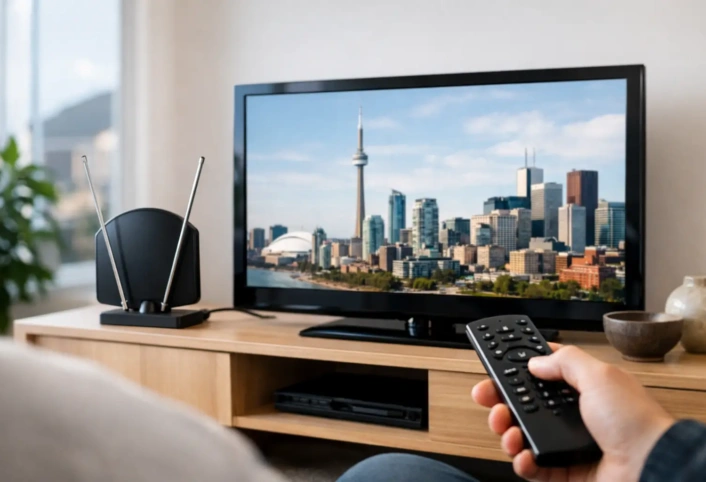
An indoor antenna can be a sensible choice for a home close to broadcast towers with minimal obstructions. It is easy to try, but it is also exposed to interference from walls, appliances, Wi-Fi equipment, and other electronics. Moving it a few feet can change channel availability dramatically.
Attic installations keep an antenna out of the weather and can provide a cleaner appearance. The trade-off is that roofing materials, insulation, ducts, and electrical wiring may reduce performance. In some homes, an attic antenna performs well. In others, it leaves too little signal margin for dependable viewing.
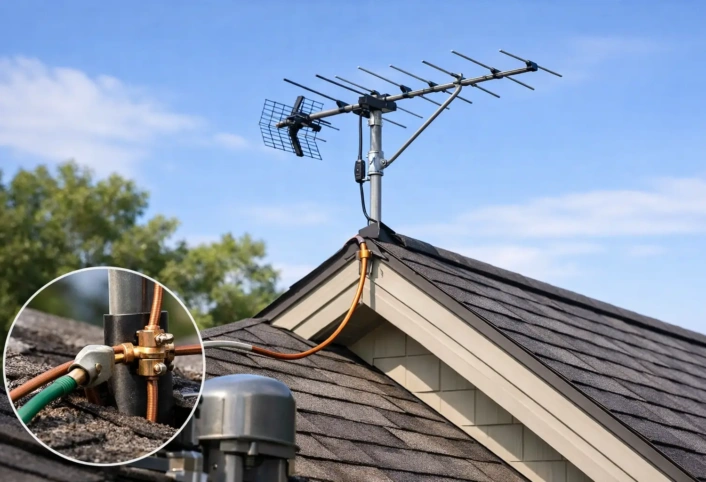
Outdoor antennas typically offer the best opportunity for consistent reception because they are placed above many indoor obstacles. They also require proper mounting, grounding, weather-rated connections, and cable routing. A professional installation is about more than securing an antenna to a roofline. It is about creating a system designed to perform safely and reliably over time.
The Equipment Between the Antenna and TV Matters
A good antenna can lose its advantage if the rest of the system is poorly planned. Coaxial cable runs, splitters, connectors, and amplifiers all affect the signal reaching each television.
Long cable runs naturally lose some signal. Splitting one antenna feed among multiple TVs also reduces the signal available to each set. That does not mean a multi-TV setup will not work. It means the distribution system needs to be sized for the home rather than assembled from whatever parts are on hand.
Amplifiers are often misunderstood. An amplifier can help make up for signal loss from a long cable run or multiple TV connections. It cannot repair a weak, noisy, or poorly aimed signal. In fact, adding amplification where it is not needed can overload strong nearby signals and create new problems. The best approach is to first capture the cleanest signal possible, then use amplification only when the system calls for it.
Loose connectors and aging cable can also cause intermittent issues that look like weak reception. If channels drop out only on one TV, the problem may be in that room’s cable path rather than at the antenna. This is why diagnosing the entire system matters.
How to Spot a Signal Problem at Home
Your television’s channel scan and signal meter can offer useful clues. If the same channels consistently pixelate, disappear, or fail to scan, there may be a reception or alignment issue. If problems occur only during rain, wind, or certain times of day, nearby obstructions, a marginal signal, or a damaged outdoor connection may be involved.
Before assuming you need a new antenna, check the simple items. Make sure the TV is set to antenna or air channels rather than cable. Confirm that coaxial connections are snug, and run a fresh channel scan after any equipment change. If you use a splitter, temporarily testing one TV directly from the antenna feed can help identify whether the distribution setup is reducing performance.
Avoid chasing every unavailable channel. Not every local station is equally reachable at every address, and some stations broadcast from different tower locations. A well-designed system focuses on the channels that matter most to your household and the best realistic reception available at your property.
When Professional Signal Testing Is Worth It
DIY testing can be useful, especially for a simple single-TV setup near local towers. But it can become time-consuming when reception is inconsistent, multiple TVs are involved, or your home has terrain and construction challenges.
A trained technician can evaluate expected broadcast coverage at your address, identify likely tower directions, assess mounting locations, and select equipment that fits the conditions. They can also test signal performance, configure distribution to the televisions you use, and help avoid common mistakes such as placing an antenna where the roof or nearby trees block the strongest stations.
That service matters because the cheapest antenna is not always the lowest-cost solution. Repeated retail purchases, extra amplifiers, trial-and-error mounting, and unreliable viewing can cost more than having the system planned correctly at the start. Antenna Master helps homeowners turn cord-cutting into a practical home upgrade, with an antenna system designed around their property and viewing needs.
Better Reception Supports Better Cord-Cutting
Strong local reception gives your household more freedom when deciding what to keep, replace, or cancel. Over-the-air TV is especially valuable for local news, weather coverage, major network programming, and live events that are harder to replace with streaming alone.
The best time to address antenna signal strength is before frustration becomes the normal viewing experience. If your picture breaks up, your channel list feels incomplete, or you are considering canceling an expensive TV package, a properly assessed antenna system can give you a clearer path forward. A custom estimate can show what reliable local HD TV may look like at your home and help you make a cord-cutting decision with confidence.