A local game should not break into pixels just as the score changes. Nor should a weather alert disappear because one room gets a weaker signal than another. Strong TV reception is what makes over-the-air television feel dependable: clear local channels, live network programming, news, sports, and entertainment delivered in high definition without relying entirely on a pay-TV package.
The catch is that reception is not determined by the antenna box alone. Your distance from broadcast towers, nearby buildings, roofline, antenna placement, cable condition, and the way signals are distributed through the home all matter. A professional approach turns those variables into a system designed for the channels your household wants to watch.
What Affects TV Reception at Your Home
Broadcast television signals travel through the air, but they do not all arrive at your home with the same strength. A house close to local transmission towers may receive many channels with a modest antenna installation. A home farther away, surrounded by taller buildings or dense trees, may need a more carefully selected antenna and a higher mounting location.
In South Florida, conditions can vary widely from one neighborhood to the next. Coastal exposure, high-rise structures, tropical foliage, and changing weather can all affect how a signal reaches an antenna. That is why a setup that works well for a neighbor may not produce the same results at your address.
The most common factors include the direction and distance of broadcast towers, obstructions between your home and those towers, antenna height, and the quality of the wiring already in place. Signal strength matters, but signal quality matters too. A powerful signal that reflects off nearby structures can create interference, while damaged coaxial cable can weaken a good signal before it reaches the television.
Indoor, Attic, or Outdoor Antenna?
Antenna location is often the biggest decision in a TV reception project. Each option has benefits, but the right choice depends on your home and local signal conditions.
An indoor antenna is the least visible option and can work well in favorable locations. It may be enough for a single television when major broadcast towers are nearby and there are few obstacles. However, indoor walls, metal framing, appliances, and electronics can interfere with reception. Moving an indoor antenna a few feet can sometimes change the result, which is frustrating when you want reliable channels every day.
An attic installation keeps the antenna out of sight and protected from the elements. It can be a practical choice in some homes, particularly where the attic has a clear path toward local towers. But roofing materials, radiant barriers, wiring, and insulation may reduce signal performance. Attic placement is not automatically better than an indoor antenna simply because it is higher.
An outdoor antenna generally provides the strongest opportunity for consistent reception because it has fewer barriers between the antenna and broadcast signals. A properly mounted outdoor system can be positioned for the best available signal path and connected to the home’s existing television wiring. It does require professional attention to mounting, grounding, cable routing, and weather exposure. For households that depend on local television across multiple rooms, that extra planning can make a meaningful difference.
Why Antenna Type Is Only Part of the Answer
It is easy to assume that a larger antenna always means better performance. In reality, the best antenna is the one matched to your location, desired channels, and installation conditions. An oversized antenna may not solve a wiring or interference issue. A smaller antenna, placed correctly, can outperform a poorly positioned larger model.
A technician begins by evaluating the signal environment rather than guessing from a retail package. This includes identifying where local stations transmit from, determining which channels are realistic to receive, and assessing whether the antenna needs to serve one television or an entire home. The goal is not to promise every channel available in the region. The goal is to build the strongest, most reliable system your property can support.
That distinction matters when you are cutting the cord. Streaming services can complement broadcast TV, but an antenna gives you direct access to many local stations without depending on internet speed or a monthly television contract. A well-planned system helps you keep the live programming that matters most to your household.
Common Reasons TV Reception Becomes Unreliable
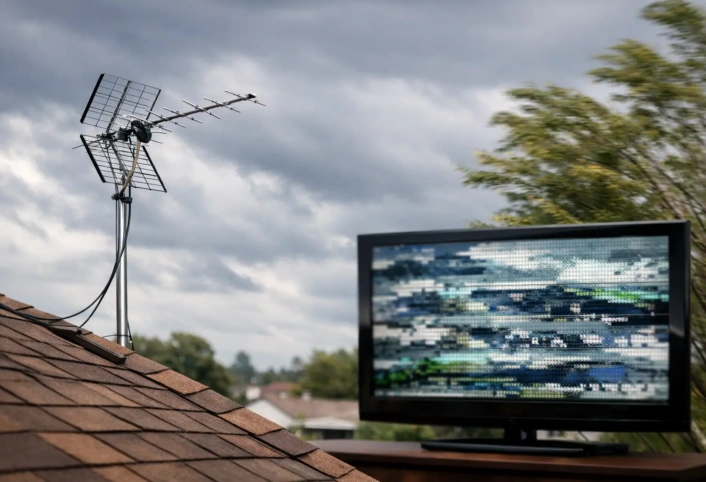
If your channels were clear before and now show pixelation, dropouts, or missing stations, the antenna itself may not be the only cause. Connections can loosen over time, outdoor cables can wear, and splitters may reduce signal quality as televisions are added around the home.
Reception problems also appear when a signal is divided too many times. Every splitter introduces some loss. In a multi-room setup, the system may need the right distribution equipment to deliver a usable signal to each television. Simply adding another splitter from a hardware store can leave the farthest room with weak or inconsistent channels.
Weather can expose an existing problem rather than create one from scratch. Heavy rain, strong winds, or moisture around a connection may affect a system that was already operating with little signal margin. If reception changes dramatically during certain conditions, it is worth having the full installation inspected instead of repeatedly rescanning channels.
Television settings can also cause confusion. Your TV must be set to receive antenna or air channels, not cable channels, and it needs a channel scan after the antenna is connected or adjusted. Rescanning can help after a station changes its broadcast frequency, but it will not fix poor antenna placement, failing cable, or an incorrectly designed distribution setup.
Getting Better TV Reception Across Multiple TVs
One television may receive local channels perfectly while another struggles. That usually points to the path between the antenna and the second TV, not necessarily the broadcast signal outside. Older coaxial runs, unused wall plates, poor connectors, and low-quality splitters are frequent causes.
A whole-home antenna system should be planned as one system. The antenna, amplifier when appropriate, splitter, cables, grounding, and television connections need to work together. Amplification can be helpful when a signal must travel a long distance or feed several televisions, but more amplification is not always better. If the incoming signal is already strong, excessive amplification can overload the tuner and make reception worse.
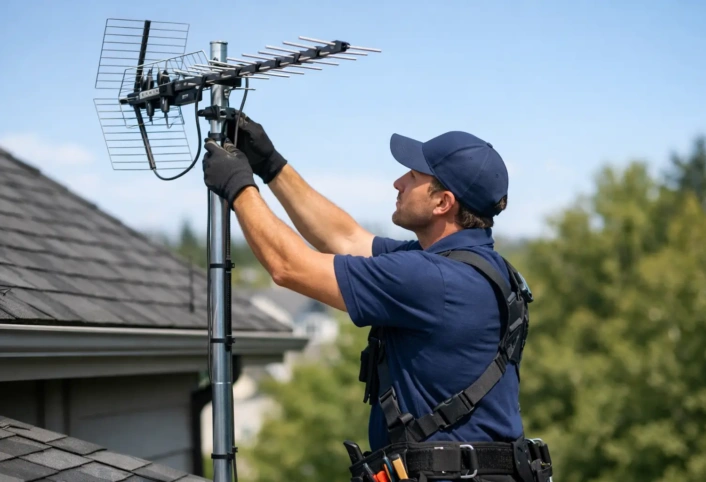
This is one reason professionally installed systems tend to be more dependable than a trial-and-error setup. A trained technician can test the signal, identify weak points, configure the equipment for the number of TVs in use, and verify that each television receives the expected channels before the job is complete.
When Professional Antenna Installation Makes Sense
A DIY antenna can be a reasonable first step for a single TV in an area with very strong signals. But professional installation is especially useful when you want clean outdoor mounting, dependable reception in more than one room, access to hard-to-receive stations, or help troubleshooting an existing antenna system.
It also makes sense when you do not want to climb onto a roof, route cable through exterior walls, or sort through conflicting antenna claims. Reception work involves more than attaching equipment to a house. Proper mounting and grounding help protect the installation, while signal testing helps avoid spending time on equipment that is not suited to the property.
Antenna Master helps homeowners in Miami-Dade, Broward, and Monroe counties turn broadcast signals into a practical home entertainment solution. With trained, recently certified technicians, the focus is on evaluating your property and configuring an antenna system around how you actually watch TV.
A Better Way to Cut the Cord
Cutting the cord does not mean giving up local news, live sports, network shows, or emergency coverage. It means deciding which services are worth keeping and using free over-the-air broadcasts for the programming already available in your area.
The strongest TV reception comes from matching the antenna, location, wiring, and distribution equipment to your home instead of hoping a one-size-fits-all device will do the job. If you are ready for clearer local HD channels and a more dependable alternative to pay TV, a professional estimate is a practical place to start.