A TV antenna installation guide should start with one practical truth: the antenna that looks strongest on the shelf is not always the one that delivers the clearest picture at your home. Broadcast signals are affected by distance from local towers, roof height, nearby buildings, trees, wiring, and even the materials used in your walls. A good installation is less about guesswork and more about matching the system to your location.
For households cutting the cord, a properly installed antenna can provide dependable access to local news, network programming, live sports, and HD broadcast channels without relying on a cable or satellite package. The goal is not simply to receive channels on installation day. It is to build a system that stays reliable when conditions change.
Start With Your Local Broadcast Signal
Before choosing an antenna, identify the broadcast towers serving your address. The direction, distance, and signal strength of those towers determine whether an indoor, attic, or outdoor antenna is the right fit.
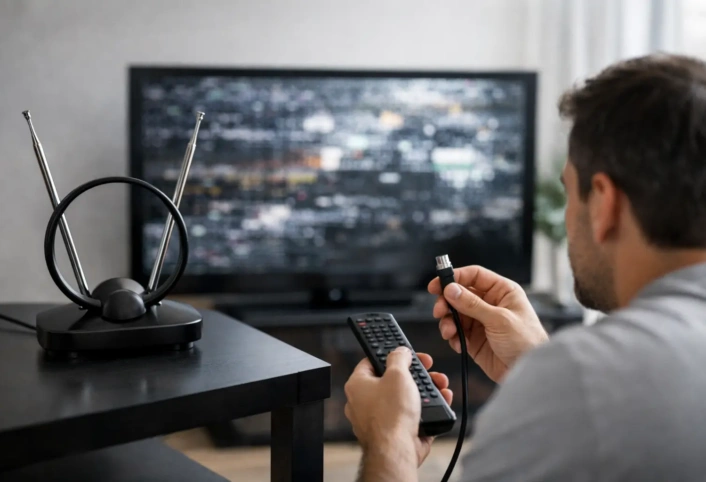
Homes located close to major broadcast towers may receive a strong signal with a compact indoor antenna. That can be convenient, but indoor placement comes with limits. Walls, windows, appliances, metal framing, and surrounding homes can weaken or scatter a signal. Moving an indoor antenna a few feet can sometimes change the available channels dramatically.
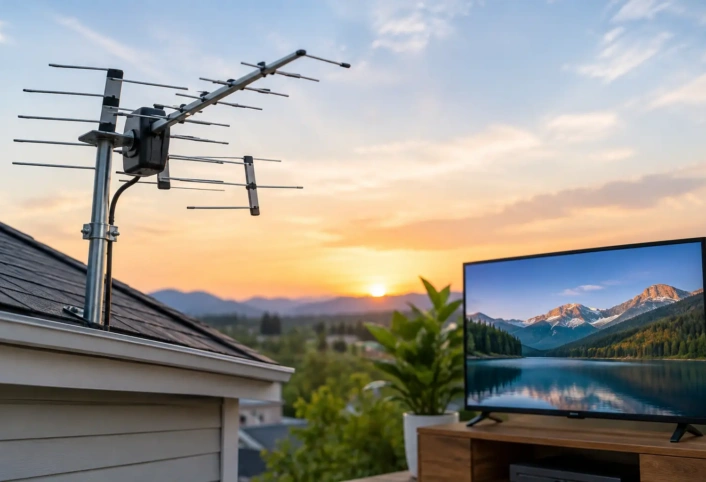
For many homes, an attic or outdoor antenna offers a more consistent result because it sits higher and has fewer obstacles in its path. An outdoor antenna is often the better choice when towers are farther away, signals arrive from more than one direction, or reliable reception matters for regularly watched local programming.
In Miami-Dade, Broward, and Monroe County, the best setup can vary substantially from one neighborhood to the next. A home near dense buildings may face different reception challenges than a home with a clear roofline, even when both are served by the same stations.
Choose the Right Antenna Type
There is no single antenna that works best for every property. The right choice depends on the signal evaluation and the way you watch TV.
An indoor antenna is a reasonable starting point for homes with strong nearby signals and one television. It is simple to place and easy to test, but it may need adjustment and may be more vulnerable to interference.
An attic antenna is protected from sun, wind, and rain while gaining more elevation than an indoor unit. However, roofing materials can reduce signal strength. Metal roofs, radiant barriers, and certain insulation materials may make attic placement less effective than expected.
An outdoor antenna generally provides the strongest opportunity for stable reception. Mounted at the appropriate height and aimed correctly, it can overcome many obstacles that affect indoor setups. It also requires proper mounting, grounding, weather-resistant connections, and careful cable routing.
Directional antennas focus on signals from one general direction. They work well when local towers are grouped together. Multi-directional antennas can be useful when stations come from different directions, though they may not match the range of a properly aimed directional model. The best choice depends on the station layout around your home, not on a one-size-fits-all label.
Find the Best Mounting Location
Height is helpful, but a higher antenna is not automatically a better antenna. The ideal location has a clear path toward broadcast towers, a secure mounting surface, and a route for coaxial cable that protects your home and the equipment.
Start by looking for obstructions. Large trees, neighboring structures, rooflines, and nearby towers can all interfere with reception. In some cases, moving an antenna from one side of the roof to another produces a larger improvement than switching to a more powerful model.
Avoid mounting an antenna too close to electrical equipment, air-conditioning components, or loose metal objects that can affect signal quality. Keep the antenna and cable away from power lines. This is a safety issue, not just a reception concern.
If your home has an existing satellite dish mount, it may seem like an obvious place for a new antenna. Sometimes it is useful, but only if the location has a favorable signal path and the mount is structurally sound. Reusing a mount without checking its direction, stability, and grounding can create problems later.
Install the System for Reliability
A quality antenna system includes more than the antenna itself. The coaxial cable, connectors, grounding, splitters, and amplifier, when needed, all affect the final result.
Use high-quality coaxial cable designed for television signals and keep cable runs as direct as practical. Every extra connection, sharp bend, damaged section, and unnecessary splitter can reduce signal strength. Outdoor connections should be weather-sealed so moisture does not work its way into the cable and cause intermittent reception.
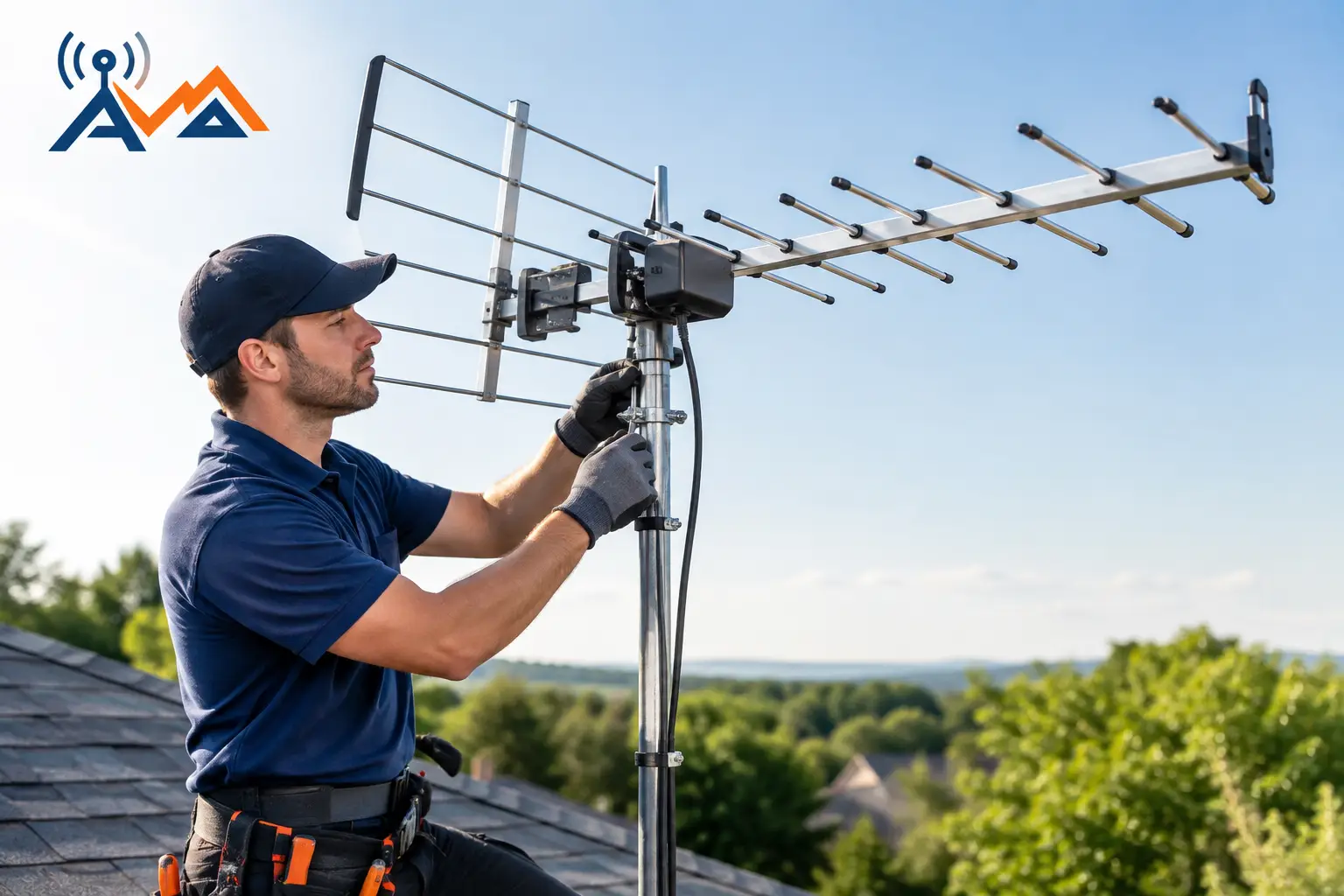
Grounding is essential for outdoor installations. Proper grounding helps protect the system and supports a safer installation. Because grounding requirements and mounting conditions can be technical, this is one of the strongest reasons to use a trained antenna technician rather than treating a roof installation as a quick weekend project.
If you need to feed several televisions, the system should be designed around that need from the beginning. Splitting one incoming signal among multiple TVs reduces the amount of signal available to each set. A distribution amplifier may help in some homes, but an amplifier is not a cure for a poorly placed antenna or damaged cable. In fact, adding amplification to a weak, noisy signal can make the problem worse.
Aim, Scan, and Test Every TV
Once the antenna is connected, aim it toward the appropriate broadcast towers and run a channel scan through each television or tuner. Do not assume a scan on one TV confirms that every room is working correctly. Different TVs and tuner devices can respond differently to marginal signals.
After the first scan, test the channels you care about most. Check local network affiliates, news stations, and independent channels at different times of day. A channel that appears during a scan but breaks up during a live program is not a reliable result.
If reception is inconsistent, make one adjustment at a time. Reposition the antenna slightly, recheck connections, and scan again. Changing the antenna direction, replacing cable, adding a splitter, and adjusting the TV all at once makes it difficult to identify the real cause.
Know When DIY Stops Making Sense
A simple indoor setup can be a worthwhile do-it-yourself project. Professional installation becomes especially valuable when your home needs roof mounting, attic access, grounding, multiple TV connections, signal troubleshooting, or a cleaner finished setup.
It also makes sense to call for help when you receive some channels clearly but cannot hold onto the local stations you watch most. The issue may be antenna direction, signal reflection, cable loss, the wrong antenna type, or interference within the home. These problems are usually fixable, but they require diagnosis rather than more random equipment.
Antenna Master approaches each installation as a reception system, not a box to mount on a roof. Trained technicians can evaluate the signal environment, select an appropriate antenna, configure the distribution to your televisions, and verify that the system performs where it matters: on the screen.
A well-planned antenna setup gives you more control over your television service and keeps local HD programming within reach. Start with the signal at your address, choose equipment that fits the property, and do not settle for a picture that only works when conditions are perfect.