A window-facing antenna can pull in a sharp local newscast in one apartment and struggle to find a single reliable channel two floors away. That is why the best antennas for apartments are not simply the models with the biggest range claim on the box. They are the antennas that match your building, your location, and the signal conditions inside your home.
For apartment residents who want local news, network shows, live sports, and weather coverage without relying entirely on pay TV, an antenna can be a smart part of a cord-cutting plan. The key is choosing the right type of system and giving it the best possible placement.
What makes an apartment antenna work?
Broadcast TV signals travel through the air, but apartment buildings can get in the way. Concrete, steel framing, low-E glass, nearby high-rises, elevators, and even the direction your unit faces can affect reception. A small indoor antenna may work beautifully in a top-floor unit with a clear path toward broadcast towers, while a larger amplified antenna may still need help in a first-floor unit surrounded by dense construction.
Distance matters, but it is not the whole story. Towers located relatively close by can still be difficult to receive when building materials block or reflect the signal. Conversely, an apartment farther from the towers may receive excellent TV when it has a clear, elevated view in the right direction.
Before selecting equipment, think about where the antenna can actually go. A television cabinet in the center of the apartment is convenient, but it is rarely the strongest reception point. A window, exterior-facing wall, balcony area, or higher shelf often produces better results.
The best antennas for apartments by living situation
There is no one antenna that wins in every apartment. The best choice depends on the access you have, the building rules you must follow, and the strength of local broadcast signals.
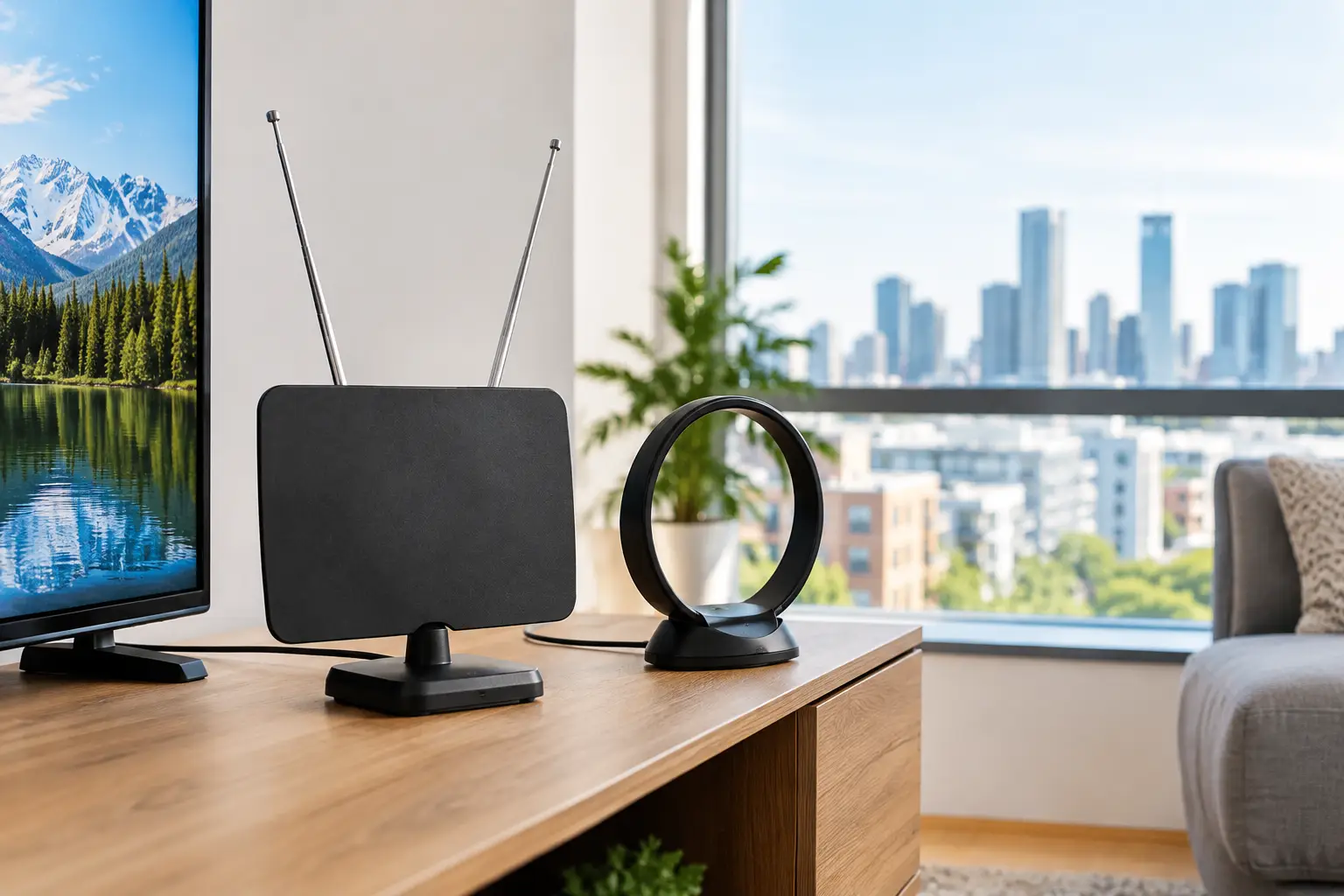
Indoor flat antennas for simple setups
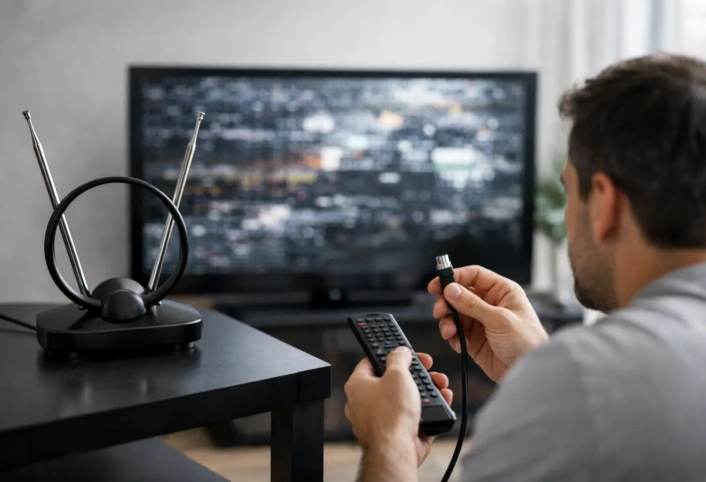
Thin, flat indoor antennas are the most common starting point for apartments. They mount easily on a wall or window, take up very little space, and connect directly to a television with a coaxial input. They are a sensible choice for renters who need a low-profile solution and have reasonably strong local signals.
For the best results, place a flat antenna high on an exterior-facing wall or directly in a window. Test more than one location before permanently attaching it. Moving it even a few feet can improve one channel while weakening another, so take time to scan channels after each move.
The trade-off is consistency. Flat antennas are sensitive to placement and may be less dependable in apartments with reinforced walls, interior-only TV locations, or heavy interference from surrounding buildings.
Amplified indoor antennas for challenging rooms
An amplified antenna includes a powered signal booster. It can be useful when the signal reaching the antenna is weak due to distance, long cable runs, or moderate indoor signal loss. In some apartments, amplification helps recover channels that a passive antenna cannot hold reliably.
But more amplification does not automatically mean better reception. A booster increases both the desired signal and unwanted noise. If your apartment already receives strong signals, an amplified model can overload the tuner and create reception issues instead of solving them.
This is why a quality amplified antenna should allow the amplifier to be turned off or bypassed for testing. Start without amplification when possible, then compare results with it enabled. The better setting is the one that delivers stable channels, not necessarily the one that displays the highest number of channels during a scan.
Window and balcony antennas for better signal access
If your lease and property rules allow it, a small antenna positioned at a window or on a private balcony can outperform an antenna hidden behind the TV. Getting closer to the exterior of the building reduces the amount of material the signal has to pass through.
A balcony installation deserves careful planning. It must be securely mounted, protected from weather, and positioned safely without creating a hazard or violating community rules. It also needs a proper cable route that does not pinch wiring in doors or windows.
For residents in dense urban areas, including parts of Miami-Dade and Broward County, a balcony or exterior-facing placement can make a meaningful difference when nearby structures interfere with indoor reception.
Outdoor or attic-style systems when permitted
The strongest apartment antenna solution is sometimes not inside the apartment at all. Some condominium owners and renters have access to a private exterior area, roof-rights arrangement, attic-like space, or building-approved common installation. In those cases, a professionally selected and installed outdoor antenna can provide more reliable reception and serve multiple TVs.
This option is not appropriate for every property. Building management, homeowner association rules, safety requirements, grounding needs, and cable pathways all matter. A professional assessment can clarify whether an exterior system is practical and whether it will provide a real improvement over a well-placed indoor antenna.
Do not choose by advertised mileage alone
Antenna packaging often promotes a mileage range, but those claims are not a dependable way to predict apartment performance. They do not account for tower direction, terrain, building density, wall construction, electrical interference, or the quality of your television tuner.
Instead, focus on the signals available at your address and the obstacles between your apartment and local broadcast towers. You also need to know whether stations use VHF, UHF, or both. Many local channels are carried on UHF, but some important network affiliates may use VHF. An antenna designed mainly for UHF may leave out channels you expect to receive.
A good apartment antenna should support both VHF and UHF when your local market needs both. That one detail can prevent the frustrating situation where several channels come in perfectly but a major network station is missing.
Placement matters more than most equipment upgrades
Once you have an antenna, placement is the first thing to troubleshoot. Keep it away from metal shelving, large appliances, Wi-Fi routers, LED light fixtures, and bundles of power cables when possible. Those items can introduce interference or block the signal.
Height is usually helpful. Try an upper wall, a high window, or a shelf near the ceiling. Keep the antenna as close to an exterior wall as practical, particularly one facing the direction of local towers. If you are unsure which direction that is, testing is still worthwhile. Run a channel scan, check which channels are stable, move the antenna, and scan again.
Do not judge an antenna only by whether a channel appears once. Watch the channels you care about at different times of day. A marginal signal may look fine during a quick test but break up later. Reliable reception means a steady picture and clear audio during the programs you actually watch.
Think beyond one television
A single-TV setup is straightforward. Multiple TVs add complexity because splitting one antenna signal between several televisions reduces the signal level reaching each set. Long coaxial cable runs can also create loss.
If you want antenna service in more than one room, use quality coaxial cable and a properly matched splitter. In some cases, a distribution amplifier is the right tool, but only after confirming that the incoming signal is strong enough and the system needs help distributing it. Adding equipment without testing can make an already weak signal worse.
This is where professional setup can save time. A technician can test the signal at likely antenna locations, identify which channels are realistically available, select the right antenna type, and configure the system for the number of TVs in your home.
When a professional installation is the better answer
DIY antennas are a good fit for some apartments, especially when local signals are strong and placement options are simple. But if you have tried several locations, receive channels intermittently, need service on multiple TVs, or want an exterior solution approved by your property, an evaluation is often more efficient than buying and returning more equipment.
Antenna Master helps households turn antenna reception into a dependable home TV setup, not another unfinished cord-cutting project. Trained technicians can evaluate signal conditions, placement options, cabling, and the right configuration for your apartment or condo.
The right antenna should make local television feel easy: turn on the TV, find the channels you want, and enjoy a clear picture. Start with placement, choose equipment based on your building rather than a range claim, and get expert help when your apartment presents more obstacles than a basic indoor antenna can handle.