A rural address can be a great place to cut the cord, but it asks more of your TV antenna system. The best rural antennas are not simply the biggest models on the shelf. They are matched to your distance from broadcast towers, the terrain around your home, and the number of TVs you want to serve. Get those details right, and you can enjoy dependable local news, network shows, live sports, and HD programming without relying on pay TV for channels available over the air.
What Makes Rural TV Reception Different?
Homes in cities and dense suburbs are often close enough to broadcast towers that a small indoor antenna may bring in several stations. Rural homes can be much farther away. Signals may travel across open land, but they can also be weakened by hills, tree cover, water, roof materials, and other structures between your home and the transmitter.
Distance is only part of the story. A home 45 miles from the towers with a clear path may receive more channels than a home 25 miles away on the far side of a ridge. That is why an antenna recommendation based only on a mileage claim can disappoint. A professional site review looks at the actual signal environment, not just the label on an antenna box.
Rural reception also benefits from a system designed for consistency. Receiving a channel occasionally is not the same as receiving it clearly through changing weather, seasonal foliage, and normal household use. The goal is stable viewing where it matters most, especially for the local stations your household watches every week.
Best Rural Antennas Start With Signal Conditions
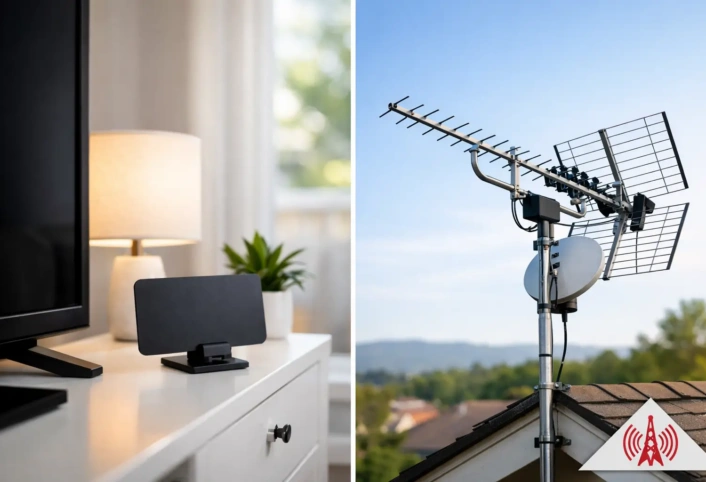
The right antenna is determined by the signal available at your property. For many rural homes, an outdoor antenna is the strongest starting point because mounting it higher and outside the home reduces the interference caused by walls, wiring, insulation, and metal roofing materials.
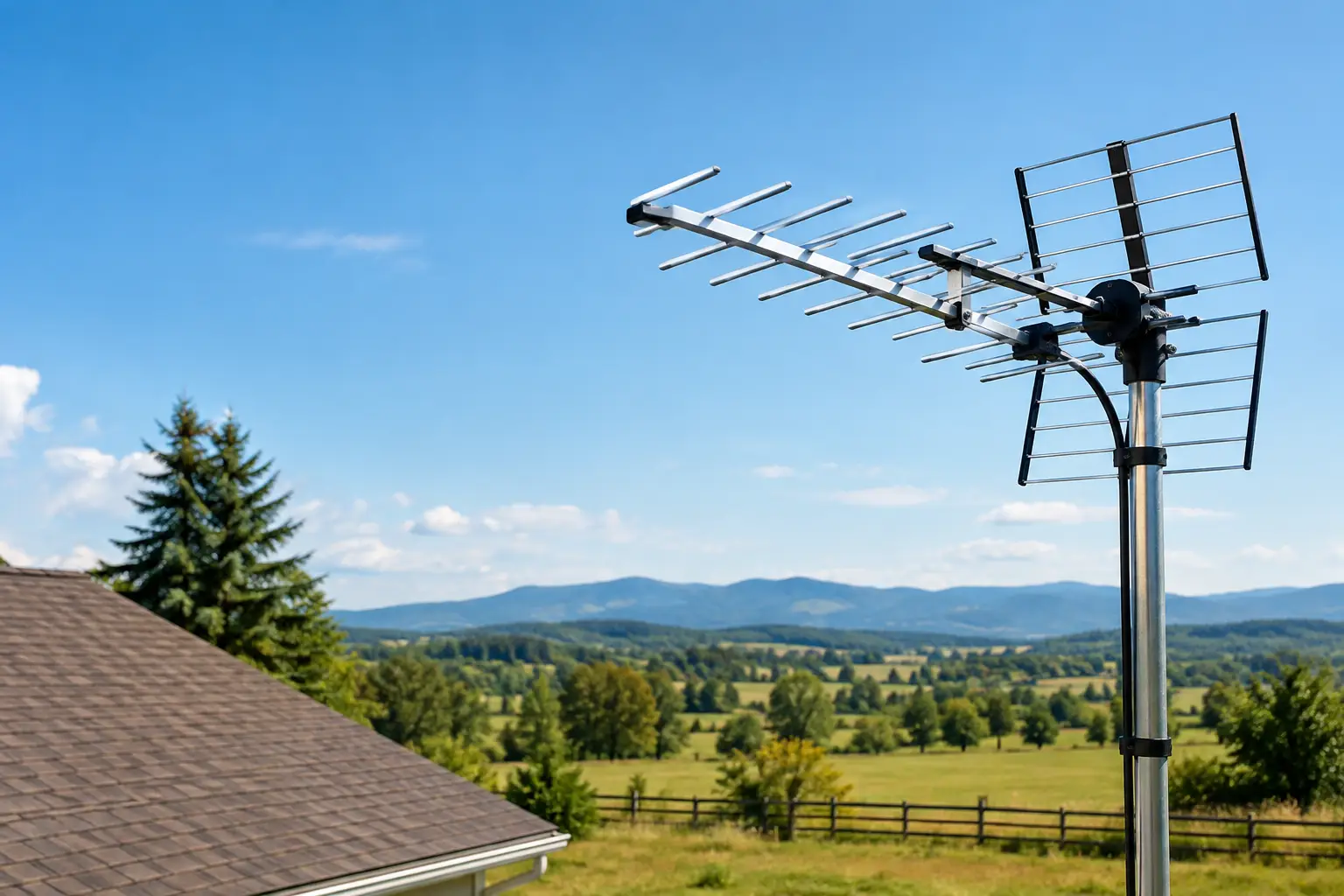
A directional antenna is often a smart choice when most local broadcast towers are located in roughly the same direction. It focuses on signals from that area and can reject some unwanted interference from other directions. This can be especially useful for households farther from the broadcast market.
A multi-directional antenna may make more sense when desired stations are spread across different directions. It offers broader coverage, though that flexibility can involve a trade-off. It may not capture distant signals as strongly as a properly aimed directional model. There is no universal winner – the better choice depends on where the towers are and which stations matter to your household.
Some rural locations need a larger, higher-gain antenna to reach distant signals. Larger does not automatically mean better, however. An oversized antenna pointed incorrectly, mounted too low, or connected with poor cable can still produce unreliable results. The full system has to work together.
Height Can Matter More Than Homeowners Expect
In rural installations, mounting height can make a meaningful difference. Raising the antenna can help it clear nearby trees, rooflines, and other obstructions. It may also improve the signal path toward the towers.
That does not mean every antenna should be placed at the highest possible point. Safe mounting, structural considerations, wind exposure, cable routing, and grounding all matter. A qualified technician can identify a practical mounting position that balances stronger reception with a clean, secure installation.
Terrain and Trees Change the Plan
South Florida does not have mountain ranges, but local obstacles still affect reception. Mature trees, dense vegetation, nearby buildings, and even a particular roof orientation can interfere with a signal path. Trees are a frequent challenge because their effect can change as foliage becomes denser or wetter.
Antenna placement may need to account for these conditions rather than simply face a general compass direction. Small adjustments in height, location, or aim can be the difference between a channel that breaks up and one that comes in clearly.
Avoid Choosing an Antenna by Range Claims Alone
Retail antenna packaging often promotes a dramatic range number. That number can be useful as a rough comparison, but it cannot guarantee reception at your home. Broadcast signals do not move through every property in the same way, and a claimed range does not account for terrain, mounting height, interference, or tower direction.
The same caution applies to amplified antennas. An amplifier can help in the right situation, particularly when a usable signal needs support after traveling through a long cable run or feeding multiple televisions. But amplification cannot create a clean signal where none exists. If an amplifier is used on a weak, noisy signal, it may amplify the noise along with it.
For this reason, amplification should be a system decision, not an automatic add-on. The antenna, mounting location, cable quality, splitters, and number of connected TVs all affect whether an amplifier is helpful.
Build a Rural Antenna System for the Whole House
A single-TV setup is relatively simple. Once you want antenna reception at several televisions, the distribution system becomes just as important as the antenna itself. Every splitter introduces some signal loss, and aging coaxial cable or loose connectors can reduce performance further.
A well-planned installation considers where the signal enters the home, how far it needs to travel, and whether existing wiring is in good condition. In some homes, a distribution amplifier may be appropriate. In others, cleaner connections and a better antenna location are the more effective fix.
This is also where professional installation saves frustration. It is easy to focus on the antenna visible outside while overlooking the equipment and connections that deliver the picture indoors. A complete setup should be tested at the televisions you actually use, not just at the antenna location.
Signs You May Need a Better Rural Antenna Setup
Picture breakup, missing channels, and channels that disappear after rain are common signs that your current setup needs attention. You may also notice that a TV receives stations when the antenna is connected directly but loses them when routed through household wiring. These problems do not always mean you need a different antenna. They may point to placement, aiming, cable, splitter, or signal-distribution issues.
If you are using a small indoor antenna in a remote area, moving to a properly mounted outdoor antenna can be a major improvement. If you already have an outdoor antenna but reception is inconsistent, the solution may be a more precise aim, a higher mounting point, or a system designed for your home’s layout.
It is worth addressing these problems before canceling a service you no longer want to keep. Reliable local broadcast reception gives your household confidence that the channels you value will be there when you turn on the TV.
When Professional Installation Is the Better Choice
DIY antennas can work well for homes with strong nearby signals and uncomplicated wiring. Rural homes often involve more variables. Climbing on a roof, installing a mast, grounding the equipment, routing cable, and testing signal quality all require care. A trial-and-error approach can turn a straightforward cord-cutting project into a long series of adjustments.
A trained antenna technician can evaluate the reception environment, select equipment based on your goals, mount the antenna safely, aim it accurately, and configure the signal for your TVs. That approach is particularly valuable when local stations are distant, the property has heavy tree coverage, or several televisions need dependable access.
For homeowners in Miami-Dade, Broward, and Monroe counties, Antenna Master provides professional antenna installation and system setup designed around the channels and viewing areas that matter to the household. The focus is simple: make over-the-air HD television a dependable part of your entertainment setup.
Choose for Reliable Viewing, Not Just Channel Count
The best rural antenna system is the one that delivers the stations you care about with consistent picture quality. A long channel list is nice, but it is less useful if your local network affiliate or preferred news station drops out when conditions change.
Start with your viewing priorities. Identify the local news, network programming, sports, and public television channels you want to keep. Then choose an antenna and installation plan based on the signal realities at your property. With the right equipment in the right location, rural TV reception can be a practical, reliable way to enjoy local HD broadcasts and take more control of your home entertainment.