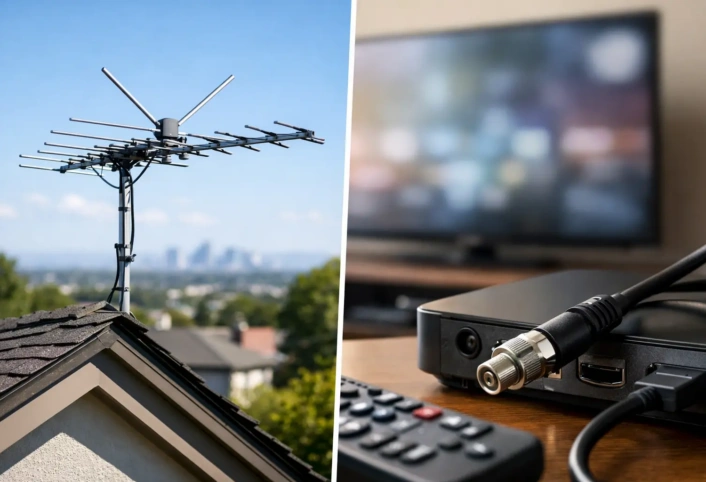
A flat indoor antenna may look like the easy answer, but it is not automatically the answer that delivers dependable local TV. If you are asking which antenna works for your home, the real question is: which antenna system can receive the broadcast signals available at your address, then deliver them reliably to the TVs you use?
That distinction matters. Broadcast TV is free to receive, but reception is not one-size-fits-all. Your distance from local towers, nearby buildings, trees, roof materials, and the number of televisions in your home can all change the result. The right antenna is the one matched to your signal environment and installed where it has the best chance to perform.
Which Antenna Works Depends on Your Location
Antenna selection starts with local broadcast towers. Homes closer to towers may receive strong signals with a compact indoor or attic-mounted antenna. Homes farther away, or homes with obstacles between the property and the towers, often need a higher-mounted outdoor antenna with greater signal range.
In South Florida, reception can also vary from neighborhood to neighborhood. High-rise buildings, dense development, mature trees, coastal weather, and rooflines can affect how signals reach a home. Two houses on the same street may not have identical results because their antenna placement and surrounding obstructions are different.
The goal is not to install the biggest antenna available. An oversized or poorly chosen antenna can be no better than a smaller one placed correctly. A trained technician looks at the broadcast signals serving your address, the direction they come from, and the practical installation options on your property before recommending a system.
Distance Is Only Part of the Picture
Signal maps are useful, but they do not tell the entire story. A home can appear close to local transmitters and still struggle if the antenna sits behind concrete walls, metal roofing, solar panels, foil-backed insulation, or tall buildings. Likewise, a home farther from the towers may receive excellent channels from an elevated outdoor installation with a clear signal path.
This is why store-bought antenna labels can be misleading. A stated range is a general marketing measurement, not a guarantee that every channel will work in every home. The antenna must receive a usable signal, and the cable, connections, amplifier, and television setup must preserve that signal all the way to the screen.
Indoor, Attic, or Outdoor: The Right Placement
Placement is often more important than the antenna style itself. Antennas work best when they have the clearest possible path toward broadcast towers. Every wall, roof layer, and obstruction between the antenna and the signal can reduce reception.
Indoor Antennas
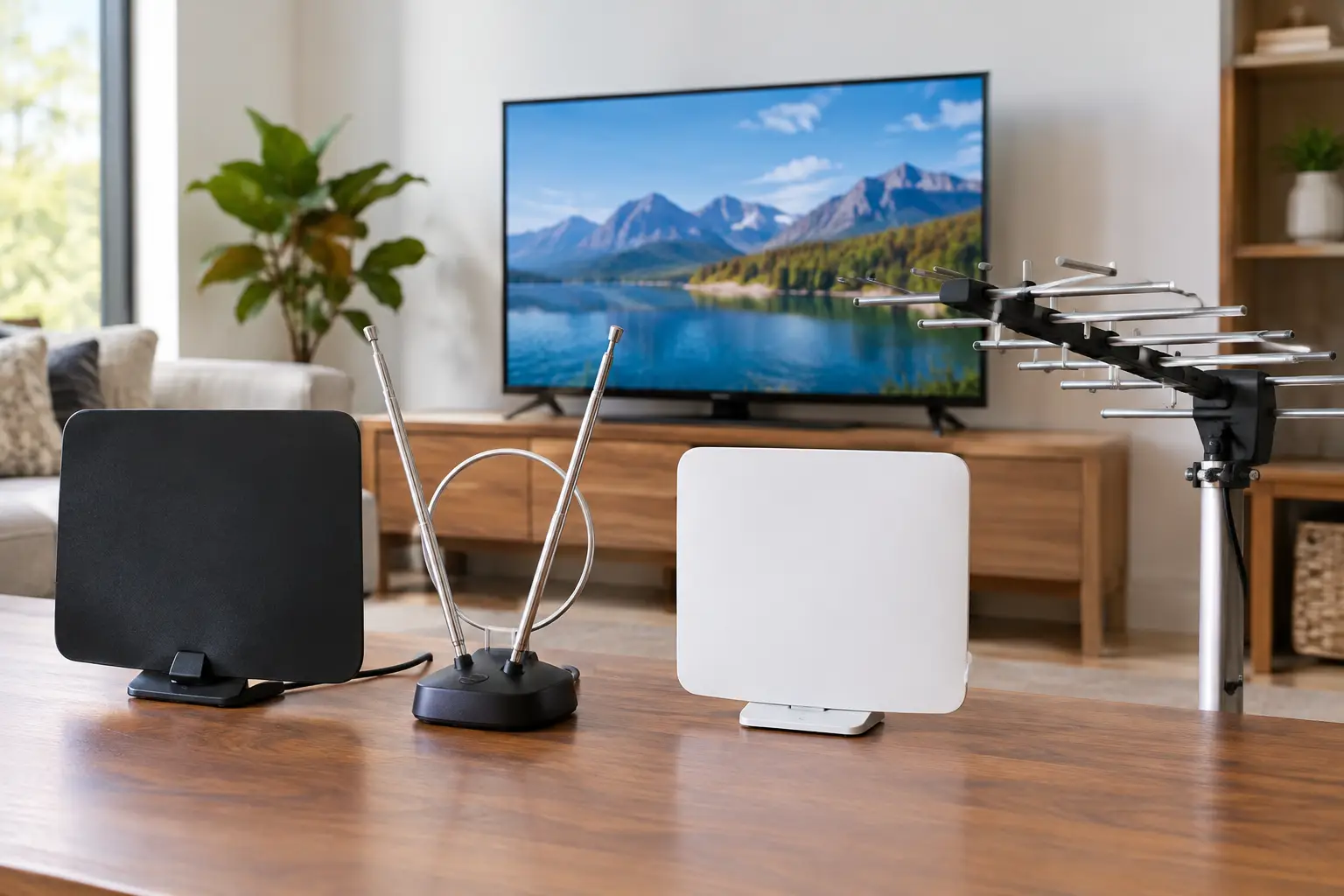
Indoor antennas can be a practical fit for homes with strong nearby signals. They are compact and easy to try, especially for a single television near a window. They can work well when conditions are favorable, but they are also the most affected by interior walls, appliances, electronics, and where the antenna is positioned in the room.
An indoor antenna may receive some channels clearly while missing others. Moving it a few feet, changing its orientation, or placing it higher can make a difference. That can be frustrating for households that want consistent access to local news, network shows, and live sports without having to adjust equipment whenever reception changes.
Attic Antennas
An attic installation keeps the antenna out of sight and protected from the weather. For some homes, it provides a good balance of performance and appearance. However, the roof and attic construction matter. Metal materials, radiant barriers, dense insulation, and certain roofing products may weaken incoming signals.
An attic antenna is worth considering when signal conditions are strong enough to overcome those materials. It should not be treated as a guaranteed substitute for an outdoor installation.
Outdoor Antennas
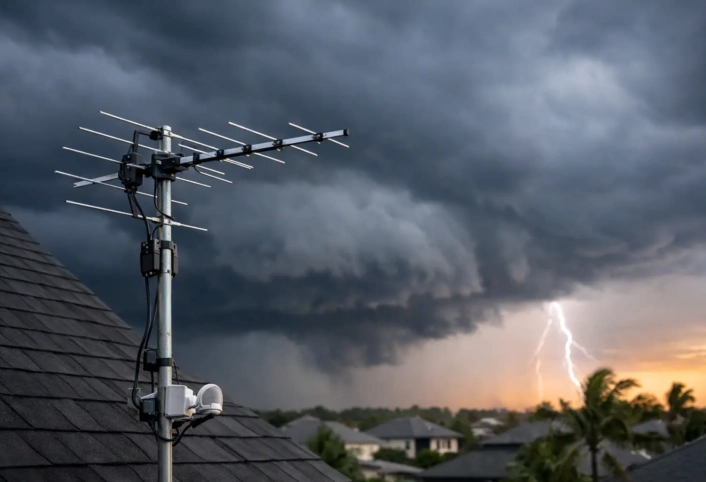
Outdoor antennas typically offer the strongest opportunity for reliable reception because they can be mounted higher and away from many indoor obstructions. They are especially useful for homes farther from broadcast towers or homes where interior and attic placement creates too much signal loss.
A properly installed outdoor antenna is not simply attached to a roof and pointed in a general direction. Mounting height, tower direction, grounding, cable routing, weather exposure, and the condition of existing wiring all affect long-term performance. Professional installation helps keep the system secure, cleanly routed, and configured for the TVs in the home.
The Antenna Needs to Match the Channels You Want
Local stations do not all broadcast from precisely the same location or on the same signal band. Most households want the major network affiliates, local news, public television, independent stations, and other broadcast programming available in their area. The antenna must be capable of receiving the frequencies those stations use.
This is one reason a basic channel scan is not enough to judge an antenna system. A television may find channels during one scan, then show pixelation, audio dropouts, or missing stations during normal use. Reliable reception requires enough signal margin to handle changing conditions, not just enough signal to briefly detect a channel.
Directional antennas can focus on signals coming from one general area and may help reduce interference. Multi-directional antennas can be useful when desired stations are spread across different directions. Neither style is universally better. The best choice depends on where the local broadcast towers are relative to your home.
More TVs Require More Than a Strong Antenna
A system that works well on one television may need additional planning when it serves several rooms. Splitting one antenna feed among multiple TVs reduces the signal available to each television. Older cable lines, loose connectors, damaged coaxial cable, or unnecessary splitters can also create reception problems.
In some cases, an amplifier helps compensate for signal loss across longer cable runs or multiple TVs. But amplification is not a cure for a weak or noisy signal. If an antenna receives poor-quality reception, an amplifier can strengthen the interference along with the channel. The better approach is to start with proper antenna placement and clean wiring, then add the right equipment only when the system calls for it.
For homes with several televisions, the installation should be planned as a complete distribution system. That includes the antenna, mounting location, coaxial wiring, splitters, signal management, and channel scanning at each TV. When those pieces work together, households can enjoy local HD programming in the rooms where they actually watch it.
Signs Your Current Antenna Is Not the Right One
Some reception problems point to a mismatch between the antenna and the home rather than an issue with the television. Frequent pixelation, channels that disappear in bad weather, different results on different TVs, or having to reposition an indoor antenna repeatedly are all signs that the setup may need attention.
It is also common for homeowners to assume their antenna has failed when the real issue is a damaged cable, corroded connector, loose splitter, or television setting. Broadcast signals are digital, so reception often appears perfect until it reaches a threshold where the picture breaks up or disappears. That all-or-nothing behavior makes a professional assessment valuable.
A technician can evaluate the signal conditions at the property, inspect existing equipment, identify wiring issues, and determine whether a different antenna location or system design would produce a better result. This saves time compared with repeatedly buying and returning retail antennas that are not suited to the home.
A Better Way to Choose an Antenna
If dependable local television is the goal, choose based on the home rather than the packaging. Consider where broadcast towers are located, what stands between them and the antenna, how many TVs need service, and whether a discreet indoor option can realistically provide the consistency your household expects.
Antenna Master helps homeowners in Miami-Dade, Broward, and Monroe counties turn those details into a properly configured over-the-air TV solution. With trained technicians and a site-specific approach, the focus is on clear local HD reception and a system that fits how your household watches television.
The best antenna is not the one with the boldest range claim. It is the one installed in the right place, connected correctly, and ready when the local news, big game, or network program comes on.